(Text modified from Dietitians of Canada)
On December 15, 2009, Dietitians of Canada, BC Region and the Community Nutritionists Council of BC released the report The Cost of Eating in BC 2009: Low-income British Columbians can't afford healthy food. The report was endorsed by 23 organizations.
Dietitians publish this annual report to bring attention to the fact that not all British Columbians have enough money to buy healthy food. While shelter and food costs have risen significantly over the past decade, income assistance rates have remained virtually unchanged and minimum wage, once the highest in the country, has remained at $8.00/hour. For those receiving income assistance or earning minimum wage there simply is not enough money to pay for housing and food, let alone other necessities. Unemployment is up and more people are relying on assistance. There are too many living in poverty in BC and too many lined up at food banks. Dietitians are calling for the provincial government to take some additional action to address poverty in this province. Other provinces are taking action. Quebec and Ontario have anti-poverty legislation, while Newfoundland & Labrador, Nova Scotia, Manitoba and New Brunswick all have poverty reduction plans. Common to them are significant changes to income assistance and increases to minimum wage.
It is well documented that income is closely tied to health. Low-income Canadians are more likely to report poor health and die earlier than Canadians with higher incomes. They spend less on food and eat fewer servings of vegetables, fruit and milk and are less likely to get the nutrients they need for good health.
To download a copy of this report, please visit Dietitians of Canada.
Thanks to Helen Yeung (Vancouver Coastal Health Community Nutritionist) for sending in this announcement.

Tuesday, December 15, 2009

Monday, December 14, 2009
War in the Country
According to Thomas Pawlick, there's a war in the country.
Pawlick is a farmer, author, and journalist who asserts that the family farm is under siege from corporate agriculture, government policy and indifferent urbanites. At stake? The quality of our food and the foundation of life in rural Canada. CBC visited him at his Ontario farm to talk about his new book, The War In The Country: How the Fight to Save Rural Life Will Shape Our Future
To listen to the interview, visit The Current (scrolling down is required).
Meanwhile, The Institute for Sustainable Horticulture/Kwantlen Polytechnic University (in cooperation with the Richmond Fruit Tree Sharing Project, the Richmond Food Security Society, and the City of Richmond) is pleased to announce that the inaugural session of the Richmond Farm School is scheduled to commence this spring. Information on courses, curriculum, practicums, fees, and more is available here.
You may also be interested in Michael Levenston's comparative analysis of urban agriculture in Montreal and Vancouver.
Enjoy!
Pawlick is a farmer, author, and journalist who asserts that the family farm is under siege from corporate agriculture, government policy and indifferent urbanites. At stake? The quality of our food and the foundation of life in rural Canada. CBC visited him at his Ontario farm to talk about his new book, The War In The Country: How the Fight to Save Rural Life Will Shape Our Future
To listen to the interview, visit The Current (scrolling down is required).
Meanwhile, The Institute for Sustainable Horticulture/Kwantlen Polytechnic University (in cooperation with the Richmond Fruit Tree Sharing Project, the Richmond Food Security Society, and the City of Richmond) is pleased to announce that the inaugural session of the Richmond Farm School is scheduled to commence this spring. Information on courses, curriculum, practicums, fees, and more is available here.
You may also be interested in Michael Levenston's comparative analysis of urban agriculture in Montreal and Vancouver.
Enjoy!
Thursday, December 10, 2009
Your Feedback Needed for the People's Food Policy Project
WHAT SHOULD A NATIONAL FOOD POLICY LOOK LIKE?
(Deadline extended to Monday December 14th)
The People's Food Policy Project needs your feedback, whether you are a concerned individual or a representative of an organization. They need you and/or your organization to participate in order for the project to reflect the breadth and depth of visions for a just and sustainable food system rooted in the principles of food sovereignty.
"We need your policy ideas, and they can be just that – ideas. At this stage in the project, we are interested in broad ideas (ex: 'We need a federal nutrition program aimed at students,' OR, 'We need to support small-scale farmers as much as large-scale farmers,' and so on). Your ideas are as important as well-developed, evidence-based policy submissions.
How and what to submit:
Submitting your policy ideas is simple. You can use work that you and/or your organization has already completed in the past. We have broadened the submission process to include reports that your organization may have already written for other purposes. You can send the entire report with relevant sections highlighted, or simply send the executive summary and recommendations of the report.
There are two ways you can submit:
1. Through our website/
You need to log in (you create your own username and password) to complete the policy submission template (Note: not all sections need to be completed).
2. By email. Send us a completed policy submission template (available on the website) OR your reports containing policy recommendations to policysubmissions@gmail.com
Further details on this process are available on the website.
Please note that you and your organization's name will not be attached to the draft policy that emerges from this process. We will be seeking official endorsement for the policies at a later time.
Should you require any clarification or information about the project and submission process, please do not hesitate to contact me at peoplesfoodpolicy@gmail.com or (514) 342-5291.
Thanking you in advance for your important contribution to this process,
Amanda Sheedy
Coordinator
People’s Food Policy Project"
(Deadline extended to Monday December 14th)
The People's Food Policy Project needs your feedback, whether you are a concerned individual or a representative of an organization. They need you and/or your organization to participate in order for the project to reflect the breadth and depth of visions for a just and sustainable food system rooted in the principles of food sovereignty.
"We need your policy ideas, and they can be just that – ideas. At this stage in the project, we are interested in broad ideas (ex: 'We need a federal nutrition program aimed at students,' OR, 'We need to support small-scale farmers as much as large-scale farmers,' and so on). Your ideas are as important as well-developed, evidence-based policy submissions.
How and what to submit:
Submitting your policy ideas is simple. You can use work that you and/or your organization has already completed in the past. We have broadened the submission process to include reports that your organization may have already written for other purposes. You can send the entire report with relevant sections highlighted, or simply send the executive summary and recommendations of the report.
There are two ways you can submit:
1. Through our website/
You need to log in (you create your own username and password) to complete the policy submission template (Note: not all sections need to be completed).
2. By email. Send us a completed policy submission template (available on the website) OR your reports containing policy recommendations to policysubmissions@gmail.com
Further details on this process are available on the website.
Please note that you and your organization's name will not be attached to the draft policy that emerges from this process. We will be seeking official endorsement for the policies at a later time.
Should you require any clarification or information about the project and submission process, please do not hesitate to contact me at peoplesfoodpolicy@gmail.com or (514) 342-5291.
Thanking you in advance for your important contribution to this process,
Amanda Sheedy
Coordinator
People’s Food Policy Project"
Saturday, December 5, 2009
Caramel apple cookies!

Volunteers Jessica, Crecien, and Louise at the Food Security table at the first annual Renfrew Collingwood Winter Craft Sale.
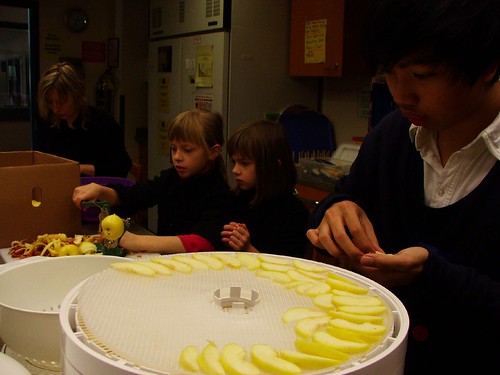
Thanks to the wonderful volunteers and vendors who made our first winter craft sale a success! Thanks especially to Andrea, Barry, Crecien, Dave, Jessica, Louise, Mary, Maya, Najia, and Olivia, who helped make cookies and cider, prepared and dried apples, cut and tied herbs and flowers, and promoted food security activities to customers.
By popular request, here are our cookie recipes:
Caramel Apple Oatmeal Cookies
Ingredients
1 cup butter
1 cup brown sugar
1 cup white sugar
2 eggs
1 tsp vanilla
1 tsp ground cinnamon
2 cup flour
2 3/4 cup old fashioned oats not quick-cooking oatmeal
1/2 tsp salt
1 tsp baking powder
1 tsp baking soda
12 oz caramel baking bits
2 cups grated apple
Method
1. In a large bowl, beat the butter, brown sugar, and white sugar with an electric mixer until the mixture is fluffy, about 2 minutes. Add the vanilla and eggs. Beat until combined.
2. Measure oatmeal into a food processor, and pulse until ground finely. In a medium-sized bowl, stir the oatmeal, flour, salt, baking powder, cinnamon, and baking soda until combined. Set aside.
3. Grate the apple.
4. Using a wooden spoon, stir the flour mixture into the butter mixture until combined. Stir in the caramel bits and apples.
5. Refrigerate the dough for 1 hour. Roll the cookie dough into golf ball-sized balls. Bake on a parchment paper-lined baking sheet in an oven preheated to 350 degrees F, for 10-12 minutes. The sheet should be placed on the upper middle rack. Cool on the pan for 4 minutes before transferring to a wire rack.
(Adapted from this recipe.)
Apricot-Pumpkin Oatmeal Cookies
Ingredients
8 ounces softened butter
1 cup white sugar
1 cup packed brown sugar
1 egg
1 teaspoon vanilla extract
1 cup pumpkin, grated or pureed
1 cup rolled oats
1 tsp baking powder
1 tsp ground cinnamon
1 tsp ground allspice
1/2 tsp salt
1 cup finely chopped dried apricots
2 1/2 cups all-purpose flour
Method
1. Preheat oven to 350 degrees F (175 degrees C).
2. Cream together butter, white sugar and brown sugar until fluffy. Beat in egg, vanilla and pumpkin.
3. In a separate bowl, mix together the oats, baking powder, cinnamon, allspice, salt, apricots, and flour. Stir into pumpkin mixture.
4. Drop cookies by the heaping teaspoonful on to cookie sheets covered with parchment paper. Bake 12 to 15 minutes or until slightly browned around edges.
Remove from oven and place on cooling racks.
(Adapted from this recipe.)
Wednesday, December 2, 2009
Renfrew Collingwood Winter Craft Fair
Collingwood Neighbourhood House and the Renfrew Collingwood Multicultural Artists' Network bring you their first annual winter craft fair!
The Fair will feature the works of 20 neighbourhood artisans, as well as hot drinks, live music, and snacks. Volunteers from The Renfrew Collingwood Food Security Institute will be there, fundraising with cookbooks, fresh organic herbs, home-grown dried flowers, cookies, and hot apple cider.
There is no admission fee. Please join us!
Where: Collingwood Neighbourhood House, 5288 Joyce St. (604.435.0323)
When: Saturday December 5: 11am-4pm
Subscribe to:
Posts (Atom)