Tuesday, November 24, 2009

Terra Madre Day Celebration


Local chefs are matched with local food at Slow Food Vancouver's first annual Terra Madre Day. Learn about food biodiversity, local cheeses, and cheer at the Red Fife wheat bake-off.

Thursday December 10
Italian Cultural Centre
3075 Slocan Street
6-9pm

Co-sponsored by Farm Folk/City Folk and the Italian Cultural Centre.
Admission by donation. Proceeds to Adopt-A-Farmer.
RSVP.


Kale Sensory Panel.

An FNH425 (Food Science Laboratory III) Kale Research Group is seeking sensory panelists for a taste assessment of a variety of steamed kale grown on the UBC Farm. Taste tests will be conducted in room 140 of the FNH Building on Monday November 30

Time slots:

Session 1: 2.00 – 2.15 pm
Session 2: 2.25 – 2.40 pm
Session 3: 2.50 – 3.05 pm
Session 4: 3.15 – 3.30 pm
Session 5: 3.40 – 3.55 pm
Session 6: 4.05 – 4.20 pm
Session 7: 4.30 – 4.45 pm

If interested, please email with your name and preferred session. Snacks and candies will be given.

Thursday, November 19, 2009

Hunger Count

Initiated in 1989, HungerCount is the only national survey of emergency food programs in Canada. The information the survey provides is invaluable, forming the basis of many Food Banks Canada activities throughout the year. Among many benefits, HungerCount allows Food Banks Canada to operate the National Food Sharing System on a "fair share" basis, present accurate, timely information to government, donors and media, and represent members' key concerns at a variety of public forums.

Food Banks Canada's "Hunger Count" report on food bank usage was released Nov 16th. This clearly written and well-referenced report and recommendations can be found here. You may be particularly interested in the British Columbia statistic on page 20.

Wednesday, November 18, 2009

Job Posting: Growing Chefs for Children's Urban Agriculture

Position: Executive Director
Organization: Growing Chefs: Chefs for Children's Urban Agriculture
Location: Vancouver, British Columbia

A Vancouver-based non-profit seeks a new Executive Director.

We seek an individual who:
* can work and communicate well with a variety of people
* has an interest in and/or knowledge of food security,
urban agriculture and sustainability
* has an interest in children's education
* is a creative thinker who wants to take our organization
to the next level

The ideal candidate will have:
* experience working with volunteers in the non-profit sector
* fundraising experience
* excellent administrative, organizational, and computer skills
* strong communications skills
* long-term strategic thinking and planning skills

The Executive Director will work variable hours, with an average of 20 hours per week, primarily from home. Core program work takes place from January to April and tapers off to July. Ongoing work continues through the year. Flexibility is essential.

We offer a competitive hourly wage, relative to candidate's experience.

ABOUT US

Growing Chefs! Chefs for Children's Urban Agriculture delivers a program with two main goals:

* To support and encourage the development and growth of children's urban agriculture.
* To provide an avenue for chefs and growers to engage in the community and to support food sustainability.

Most importantly, we wish to inspire children with the idea that they can grow their own food, even in the city.

Our program sends teams of volunteer chefs into elementary schools, where they teach kids to grow and cook their own food.

Check out http://www.growingchefs.ca for more information.

HOW TO APPLY

Interested applicants can send a resume including references to admin@growingchefs.ca Please title your email GCJob. Unfortunately we cannot respond to email inquiries at this time.

Applications can be mailed to:
Growing Chefs! Chefs for Children's Urban Agriculture
2119 Guelph Street
Vancouver BC V5T 3N7

Applications by mail or email only, please. We thank all applicants for their interest, but only selected candidates will be contacted.

Saturday, November 14, 2009

UBC Farm: Sowing Seeds Practicum

Type: eight-month practicum/internship; course fee
Organization: Centre for Sustainable Food Systems at the UBC Farm
Location: University of British Columbia, Vancouver BC

Established in 2008, this part-time (600 hour), eight month practicum offers instruction and daily work experience in small-scale sustainable farming. In a balanced, hands-on learning approach, students work alongside staff in the
greenhouse, gardens, fields, and orchard. Students attend complementary lectures, demonstrations, and farm visits, and participate in a variety of practical and reflective educational activities. Direct marketing activities are also a key part of the experience. The practicum has been designed as a beginning point for aspiring growers, educators and agricultural professionals.

Students come from all backgrounds and are expected to be passionate about pursuing a career in sustainable agriculture. A certificate of completion will be issued to
students who fulfill the practicum requirements. Further, we support our graduates to make connections within the BC agricultural community, and to seek out mentors to learn with following Sowing Seeds. Please note, Sowing Seeds 2010 is a non-credit course and therefore participants are not eligible for student loans. However, in 2010 we are offering a fee discount for UBC students who register, and successfully
earn credits, for a directed studies based on their Sowing Seeds Practicum.

Course Logistics:

Course dates : March 13 - Nov 6, 2010

Course hours : Vary throughout the growing season from 7 to 21 hours/week. See our Program Overview for details.

Course fee : $3,000

**(UBC Students who register, and successfully earn credits, for a directed studies course based upon their Sowing Seeds Practicum are eligible for a $400 refund)**

Capacity : 10 students

Applications: Application information is available on our website. Application deadline: December 1, 2009.

For more information, please:

* Visit our Website and download our Program Overview
* View photos from the 2008 practicum
* Watch a short video about the practicum in 2008 (scroll down: "A Unique Urban Agriculture Course at UBC Farm")
* Read about the practicum on our blog

http://www.landfood.ubc.ca/ubcfarm/apprenticeship.php

Contact Information:

If you can't find the info you need on our website, please
contact Elaine Spearing.

Thursday, November 12, 2009

Intercultural Community Gardens - Job Opportunity

Project Coordinator, Downtown Peninsula Intercultural Gardens Project YMCA Connections, YMCA of Greater Vancouver
Based in Vancouver Full-time Contract Position ending May, 2011
Salary: $45,000 per year with benefits

Situation:
The Downtown Peninsula Intercultural Community Gardens Project is a strategy to use the transformation of public space to develop capacity at a community level to be more welcoming, inclusive and engaged. This multi-organizational initiative is designed to enhance the sense of belonging by immigrants, including refugees, within the community and to develop a sense of interconnectedness between all of the diverse groups that make up the Downtown Peninsula through the following goals:
*
* *
To better understand the needs of new immigrants residing in the area and endeavouring to meet those needs effectively and efficiently through cooperative efforts.

To build intercultural competence throughout the Downtown Peninsula community.
To create physical and intellectual spaces that promote intercultural and intergenerational dialogue.

Nature and Scope of Position:
This is a full-time contract position to May, 2011, based out of the YMCA Connections office with off-site duties. The Project Coordinator (PC) works with a Steering Committee and technical staff to plan and implement this project. She/he reports to the Manager of YMCA Connections. The PC will be capable of working independently and in a team context, and be able to work flexible hours (some evenings and weekends). This is an exciting project with tremendous potential - the PC will be bring competence as well as motivation and enthusiasm to this project.

Responsibilities include, but are not limited to:
* Coordinating the overall project, in consultation with the Steering Committee and other staff
* Community outreach within a very diverse community
* Locating appropriate garden sites and assisting with negotiating agreements for the sites
* Recruiting culturally diverse gardeners within the Downtown Peninsula
* Developing and organizing training for prospective gardeners on diversity and community gardening
* Working with gardeners to develop systems, including governance, that ensure the survival and continuity of the gardens
* Based on community feedback, to developing ancillary programming (e.g. community kitchen)
* To complete required administrative work
* To evaluate and report on the program

Qualifications: The person in this position must have:
* A minimum of 3 years of community based work in a diverse, urban context
* Superb organization, planning, communications and marketing skills
* Significant intercultural and/or immigrant service experience
* Excellent facilitation and group dynamics skills
* A post-secondary degree in a relevant discipline
* Good computer skills
* A valid BC driver's license

Desirable skills or qualities:
* Experience with, and understanding of community gardens and organic gardening
* Thorough knowledge of the Downtown Peninsula, geographically and socio-demographically
* Knowledge of the non-profit and immigrant service sector in Vancouver
* Previous program or project development experience, including partnership development
* Knowledge of other languages relevant to the Downtown Peninsula
* Previous experience working with translators and interpreters

If you are interested in this position, please send a resume and a cover letter which clearly and succinctly explains why you are qualified by Friday, November 20. Email submissions are preferred. Please send the letter and resume in the same attached file to:

Manager, YMCA Connections
YMCA Community Services and International Development
Email: linda.rubuliak@vanymca.orgProject Coordinator, Downtown Peninsula Intercultural Gardens Project YMCA Connections, YMCA of Greater Vancouver Based in Vancouver Full-time Contract Position ending May, 2011
Salary: $45,000 per year with benefits

Tuesday, November 10, 2009

The Real Dirt on Farmer John - Film and Discussion

Please join us for The Real Dirt on Farmer John by Taggart Siegel

An epic tale of a maverick Midwestern farmer. An outcast in his community, Farmer John bravely stands amidst a failing economy, vicious rumors, and violence. By melding the traditions of family farming with the power of art and free expression, this powerful story of transformation and renewal heralds a resurrection of farming in America. The film is a haunting odyssey, capturing what it means to be different in rural America.

Thursday November 12, 7pm
5288 Joyce St., Vancouver BC
FREE

* * *

The Renfrew Collingwood Garden Club/Workshop Series meets every second Thursday of the month from 7-8:45. It’s a place for gardeners to meet other gardeners--for workshops, film nights, talking circles, healthy snacks, and building community through food-growing. You are welcome to bring a potluck snack and a friend; we bring the tea and coffee.

Nourishing stories

Click below to watch a ten-minute documentary about the Farmers' Market Nutrition Coupon Program, featuring several of our program participants. We had an amazing time this year, and hope to host the program again in 2010!

Although the 2009 coupon program has drawn to a close, community kitchens will continue throughout the winter and spring.

Space is limited so please contact us to register in advance. Participation is free, but registration priority is for people who live or work in the Renfrew Collingwood Neighbourhood. We also need to know if you have child-minding needs.

Last Wednesday evening of the month: 5-8pm
Middle Sunday of the month: 11-2:30

Next up: Sunday November 15 11-2:30. Traditional vegetarian recipes from India. Our volunteer kitchen leader will be Renfrew Collingwood resident and part-time Neighbourhood House staff member Kiran Virma.

Saturday, November 7, 2009

The art and science of home canning

thank you, vancouver fruit tree project!
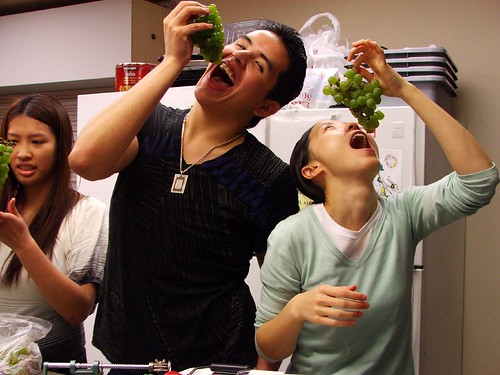
Canning workshop with delicious home-grown grapes.

Canning!

Home canning is both an art and a science. There is lots of potential for innovative flavour combinations and your own personal touch--but there's also potential for food spoilage and contamination.

Don't be intimidated by the risks--preventative measures are built on simple common sense. Specific new knowledge (such as recommended processing times for jars and types of food) is easily accessible in library books or on internet sites.

Beware! Anyone with any level of expertise can claim to be an internet expert. If in doubt, check out your good old local library for materials guaranteed to be rigorously reviewed. Be aware that our knowledge of food safe practices has improved dramatically in the last 25 years or so. Some traditional family recipes (including methods and processing times) are now known to be unsafe.

To be on the safe side, canning recipes from before 1990 should not be used, especially if they do not include instructions for processing. For example, some recipes call for the "open kettle method." In this method, food is prepared, placed in a jar, and stored. The jars aren't heat-processed at all. This method presents a serious food safety hazard.

At the library, choose materials published in the mid 1990s or later. One excellent (though not very colourful) resource is the 1994 USDA Complete Guide to Home Canning. This version contains important updates from earlier editions.

Until about 50 years ago, home canning techniques were common household skills. Today we are witnessing the rising popularity of local food, and a growing awareness that the preservatives in commercially-processed food are harmful to our health. A renewed interest in home canning is part of this movement.


Following up on an earlier post on home canning in a historical context (click the image above to flip back), here are some highlights of our canning season, and some words about safe canning practices.
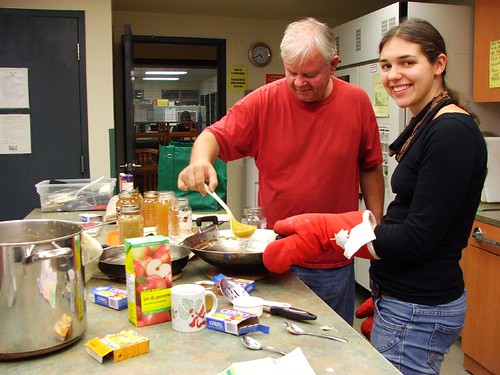
grape jelly, fingers crossed
Barry and Jessica filling jars with grape jelly.

Jars: Regular and wide-mouth Mason-type, threaded, home-canning jars with self-sealing lids are the best choice. These jars and lids are inexpensive and can be found at most hardware and grocery stores. With careful use and handling, the jars may be reused many times. They only require new lids each time.

When jars and lids are used properly, jar seals and vacuums are excellent and jar breakage is rare. Some jar brands you might find at the store include Bernardin, Kerr, and Ball.

Any jar labeled "Mason" will be compatible with the Mason standard metal screw band and lids. These include certain jam and pasta sauce jars. We have had good experiences using Classico pasta jars, but be aware that the Classico company does not recommend using the jars for home canning.

Make sure to inspect jars carefully before use, as seemingly insignificant scratches or chips weaken the integrity of the glass. This can make jars more prone to breaking during heat processing, which can be messy and dangerous.

Prior to use, jars should be washed in hot soapy water and rinsed. Boil for 10 minutes to kill bacteria, and leave jars in the hot water until you fill them up. This prevents cracking that is sometimes caused from pouring hot food into cold jars.
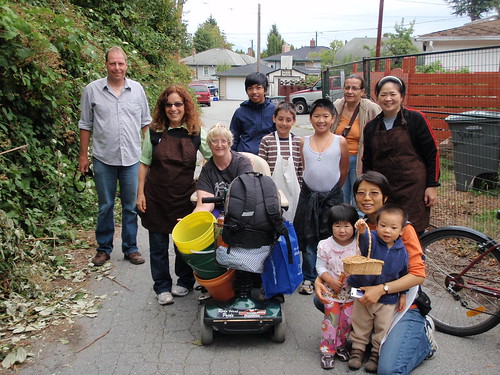
blackberry picking outing (photo by Shannon Rees)
Program participants setting out to pick wild blackberries in Renfrew Ravine.

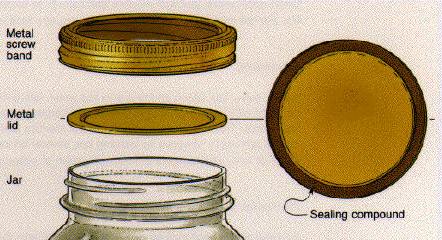
Rings and lids: It is best to use reusable metal screw bands with one time use lids (pictured here). Don't reuse old lids as they will not form a proper seal and the risk of contamination is high.

When canning, wash lids in hot soapy water, and rinse well. Place lids in HOT, not boiling water, for 5 minutes before using. This helps to melt the wax inside the lids and will form a better seal when heat processing. When sealing jars, try not to touch the underside of the lid to reduce potential bacteria transfer. The rings can be reused and are really only to hold the lids down during heat processing.

Most two-piece lids will seal with a "pop" sound while they’re cooling, as the lid gets sucked down by the vacuum created by the contents cooling and contracting inside the jar. After cooling jars for 12 to 24 hours, remove the screw bands and test seals.

You can press the middle of the lid with a finger or thumb. If the lid springs up when you release your finger, the lid is unsealed. Or try tapping the lid with the bottom of a teaspoon. A clear ringing sound means a good seal. If it makes a dull sound, the lid is not sealed.

Some traditional methods call for sealing jars using paraffin wax. Although paraffin sealing wax is available in the canning section of the grocery store, this method is no longer recommended.
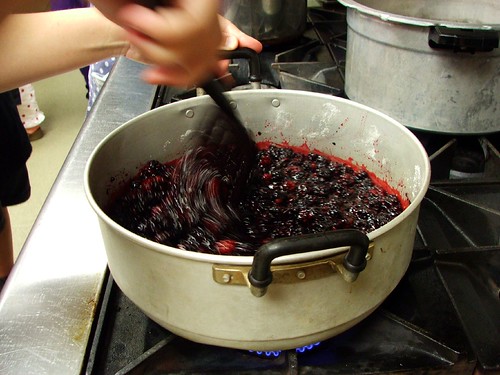
blackberries reducing
Blackberries reducing. If possible, use stainless steel or glass pots for this process. An aluminum pot like this one may affect flavour.

Pectin: Pectin is a natural product made from fruit. If you feel ambitious, you can even make your own from lemon seeds, apple peels, and cracked plum pits (don't try this with peach pits or apple seeds! They contain harmful substances). Pectin helps your jam or jelly to set. You can make preserves without pectin, but need to add LOTS more sugar and/or cook fruit for longer and/or freeze your preserves. I personally don't think it's worth the trouble, from a nutritional or storage perspective.

There are a lot of amazing-sounding recipes available in books and on the internet. Remember that each pectin brand and product is slightly different and will call for specific quantities of fruit, and a specific order of operations. Most pectin packages come with free recipes inside the box--use these recipes as your basic guide, and modify according to your other recipe ideas. Otherwise you might be disappointed by preserves that are too watery or too stiff.

On a related note, even in the midst of a bumper crop, it's inadvisable to double or triple a recipe. If you've got a glut of fruit, it's better to do two smaller batches than one giant batch, even if you plan to double every ingredient precisely. Bigger batches require longer cooking times, which can result in runny or watery preserves.
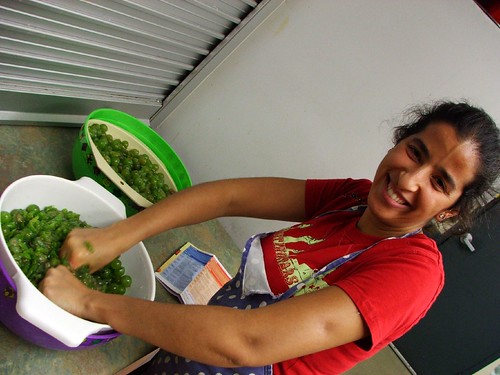
najia pummelling piles of organic grapes
Najia crushes a bowl of donated home-grown grapes to make jelly. As a group of local seniors advised us, a good jelly can't be hurried. If you're going to make preserves, make sure you have lots of time. We all tend to take shortcuts when we're in a hurry, and these shortcuts can result in less-than-desirable products.
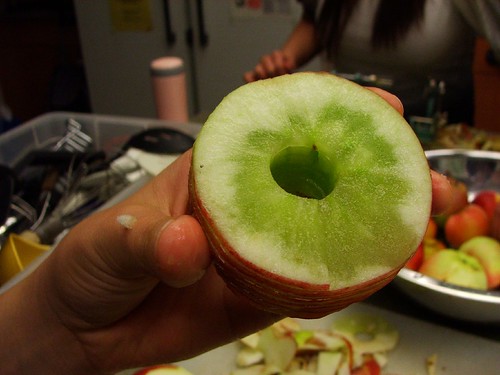
frostbitten apple?
Is this a frostbitten apple? We have no idea.

Fruit! What kind of fruits can be canned? The answer is...almost any kind of fruit or vegetable can be safely canned--but not all can be safely canned at home.

To avoid disappointing results, avoid under- and overripe fruit. Recipes are designed for perfectly ripe fruit and you might end up with overly stiff or overly watery results. I once combined 50% under ripe and 50% overripe plums and got pretty good results, but hey, maybe I was lucky.

As a general rule, fruits (such as strawberries, plums, and blackberries) have a high acid content and should be cooked, jarred, sealed, and processed in a boiling water bath. Vegetables (such as corn and beans) are low in acid content and therefore have a greater tendency to spoil. They should be processed in a pressure canner, where the higher heat and pressure will kill bacteria more easily. Pressure canning is a whole other topic with specific sets of safety recommendations.

Some fruits have a low acid content--notably figs and Asian pears. You can still make preserves with low acid fruits but you'll want to add lemon juice, heat process as usual, and store the jars in the fridge.

*Note: Pumpkin and squash should not be canned at home. It's not a good idea! Even a pressure cooker won't necessarily kill all the bacteria. The risk of contamination is too high. On the bright side, you can definitely freeze pumpkin pulp for winter pies and pudding galore.

Unsure of the acid content in your fruit of choice? It's best to consult a reliable guide before proceeding.
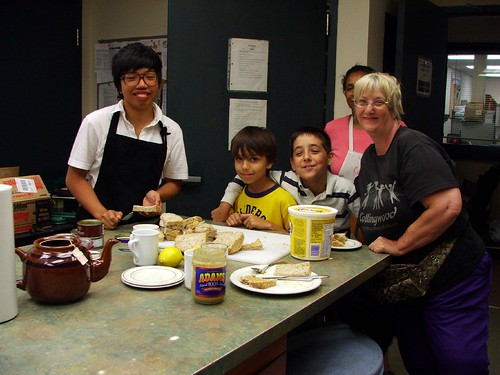
the tasting committee
The tasting committee: at the end of the workshop, participants snacked on fresh blackberry and fig jam with peanut butter and whole wheat toast.
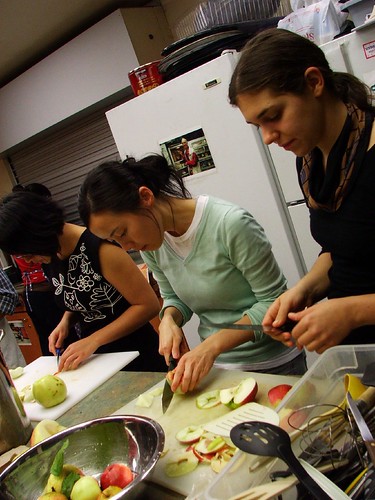
steph, pearl, and jessica
You can improve efficiency and safety of home canning by setting up clean and organized work stations. This is especially helpful when you've got a large group participating.
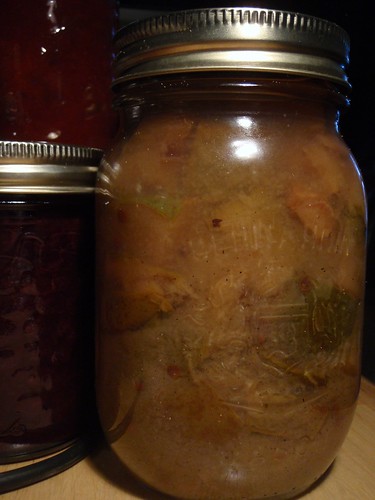
botulism
Unlabeled jar of food poisoning mystery. I found this at the back of my cupboard and it's apparent from the cloudiness and discolouration that it isn't safe to eat. Interestingly, it smelled (suprisingly) fine once opened, which just goes to show you appearances can be deceiving. Make sure to label your preserves jars with dates and contents to avoid lethal mysteries like this one.
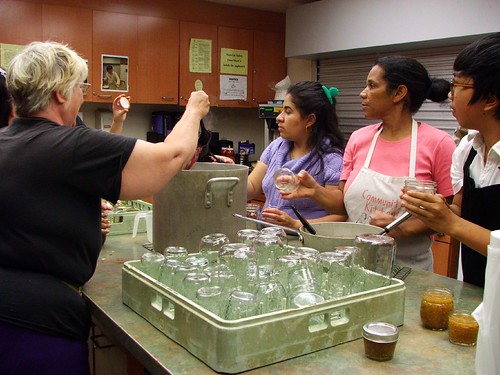
"don't touch the inside of the lid"
"Don't touch the inside of the lid!"

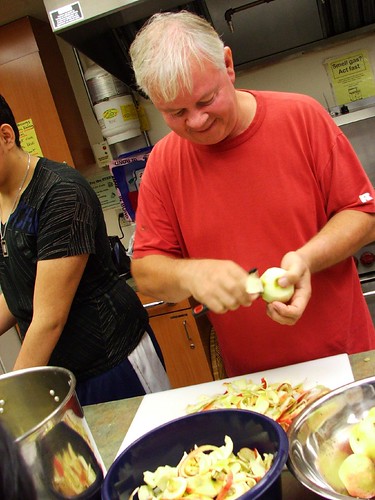
barry, master of the paring knife
Barry, master of the paring knife.

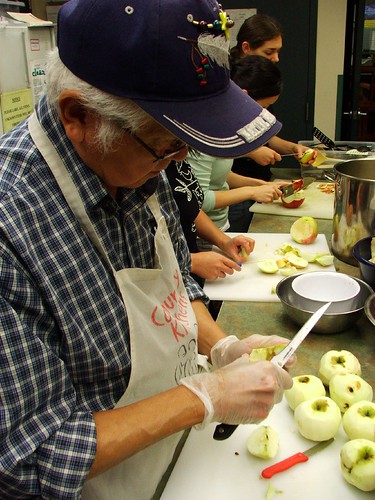
dave
Dave, slicing apples. Disposable gloves are part of good food safe practices, however, many people feel a sense of false security while wearing gloves. They are only effective against contamination if changed regularly, which many people forget to do. Frequent, proper hand washing throughout food preparation is more effective than improper use of disposable gloves.

The fruit used in our canning workshops is locally-grown and often organic. It is donated by local residents through the Grow-a-Row Share-a-Row program, or donated via the Vancouver Fruit Tree Project. Blackberries are picked by volunteers in one or more excursions to the beautiful Renfrew Ravine.

This coming week, Vancouver Fruit Tree Project will be hosting a celebration of their amazing work. Please see the invitation here.


Other canning resources.

Fresh Choice Kitchens is the Community Kitchen program of the Greater Vancouver Food Bank Society. Earlier this year, they hosted an inspiring group of local leaders in a "train-the-trainer" workshop on safe canning practices. Tara Moreau of SPEC (Society Promoting Environmental Conservation) reflected on this experience on the SPEC blog. You can read her thoughts here.

The USDA Complete Guide to Home Canning: here.

The National Centre for Food Preservation: here.

Pick Your Own.Org (slightly disorganized but full of recipes and helpful advice): here.
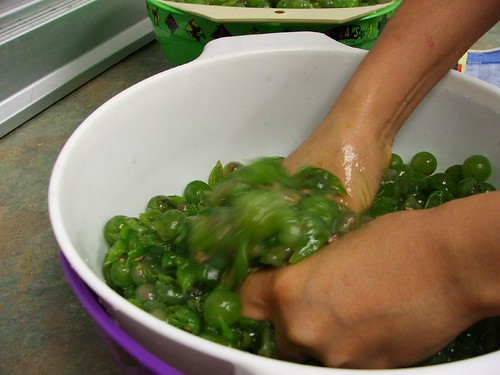
smooosh

Monday, November 2, 2009

Buggy about bugs?

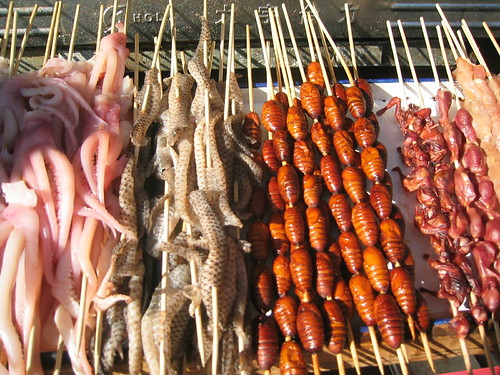
I'm really not sure what those orange ovals are
Skewered silkworm pupae, a popular street snack in Beijing.

Edible Insects.

"There are so many good and tasty reasons to eat insects that the 20-per-cent minority of Earthlings who don’t practice entomophagy – insect eating – should listen up.

Ants, termites, locusts, grasshoppers, crickets, beetles, caterpillars and moths are among some 2000 species of insects enjoyed as snacks and seasonal delicacies by most people in the world, especially those to the South and East who remain closely connected to their aboriginal and folk food heritages."


Read the rest of Wayne Roberts' fascinating foray into the world of edible insects--nutritionally dense, low in cholesterol, and shunned as food by about 20% of the world's population.

"Food safety authorities may be the fly in the ointment, since they’re the ones who insisted on working the bugs out of Western food preparation. They rate insect “infestation” a greater danger than antibiotic “infestation” in cooped-up fish, chicken and cows, or pesticide “infestation” in fruits and veggies. But even our food police permit some bugs to get into our soup. The US Food and Drug Administration allows, for example, up to 75 pieces of insects in 55 millilitres of hot chocolate and up to 60 aphids in a portion of frozen broccoli."

Hmmm.....