Friday, October 30, 2009

Creating a Pollinator's Paradise

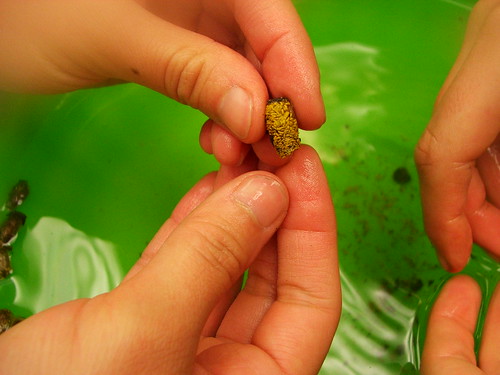
parasitic mites on female mason bee cocoon
Parasitic mites cluster around a female mason bee cocoon.

According to the Canadian Wildlife Federation, approximately one-third of all human food is prepared from plants which depend on animal pollination. Of all animal pollinators, bees do the large majority of the work.

Most Canadians are familiar with honeybees and bumblebees, but in fact, there are about 800 types of bees in Canada alone. Some live in large colonies, others are solitary or live in small groups. Some build hives in high places, others dig small burrows underground, or nest in hollow twigs.

In recent years, scientists have noticed a marked decline in bee populations. Many farmers in Canada even rent travelling beehives to help pollinate their crops because there aren't enough wild bees around to guarantee a good harvest. There are many theories about why bees are slowly vanishing--some theories include climate change stress, increased pesticide use, widespread monocrop food growing practices (less pollen diversity leads to undernourished and unhealthy bees), and fragmentation and degradation of natural habitats.

Declining bee populations will have a major impact on garden plants, wilderness areas, and food crops. To address these issues, and to raise awareness of the importance of bees to our food and ecosystems, Environmental Youth Alliance has partnered with around 150 volunteer "bee stewards" in the Vancouver area. These volunteers are helping to create bee-friendly habitats in our urban environment. Through the Pollinator's Paradise project, voluteers can take simple steps to support a healthy bee population in the city, such as "beescaping" and monitoring bee activity.

The focus of the Pollinator's Paradise project is the blue orchard mason bee. They are non-aggressive (they don't sting), native to the area, multiply easily, and are extremely effective pollinators (they love apple, cherry, and pear trees). Mason bee stewards throughout the city care for bee "houses," "high rises," or massive "superlodges." They plant flowers and trees preferred by bees ("beescaping"), and reporting on bee activities each month.

At the Food Security Institute, we host two small mason bee houses on the Rooftop Garden, and one "highrise" at the Collingwood Community Garden. On the Rooftop Garden, volunteers planted a border of edible and bee friendly flowers. These included: borage, coneflower, three types of sunflower, marigolds, lavender, calendula, and nasturtiums. These flowers, along with the many flowering fruit and vegetable plants, attracted several different types of bees throughout the spring and summer. Planting flowers in a variety of shapes and colours helps invite an assortment of pollinators as well. We noticed bumblebees preferred borage flowers:
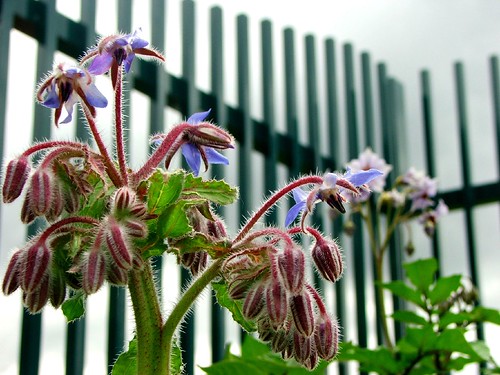
borage
Borage

Many tiny bees flocked to these carrot flowers. Perhaps their small size gives them better access to pollen in the tiny flowerheads:
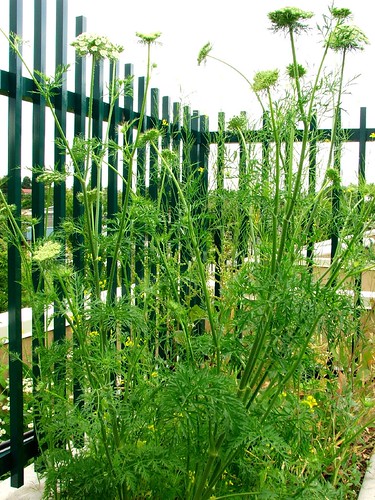
same plant family as Queen Anne's lace
Flowering carrots

For more information, or to volunteer as a bee steward, please visit The Pollinator's Paradise website.

Here are some other photo highlights of our bee activities.
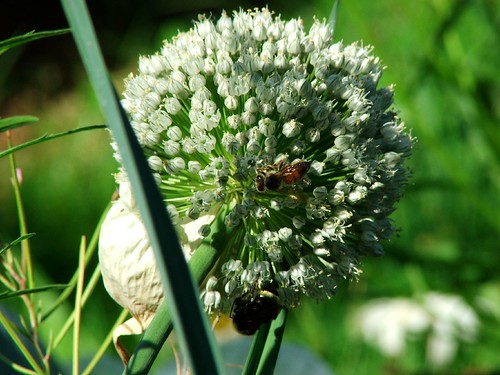
bzzz
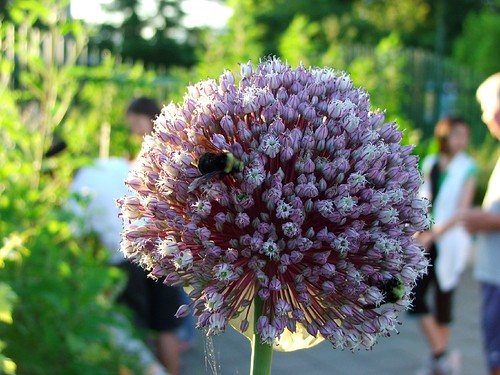
Two types of bee on an onion flower.

bzzzz
Allium flowers were surprisingly popular with the bees.
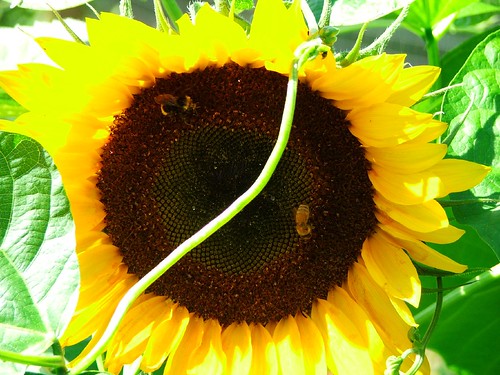
double bee sunflower action
Bees can't see the colour red, so yellow, blue, and purple flowers are good beescaping choices.
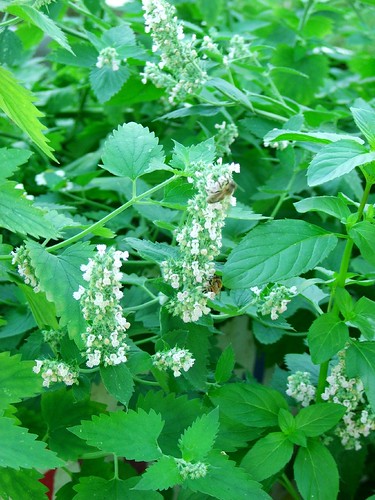
bees on catnip flowers
Catnip flowers. We also noticed that honeybees crowded around the spicy purple oregano flowers.
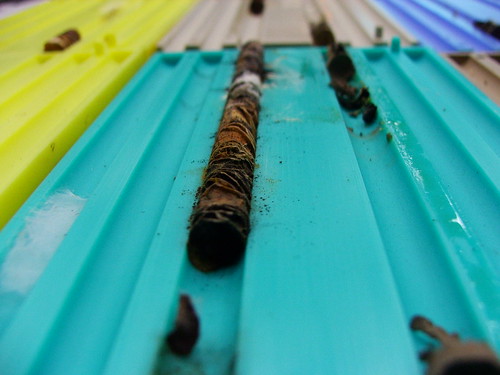
leafcutter bee cocoons
In late fall, mason bee houses should be opened up, cocoons collected, and trays cleaned. We discovered that leafcutter bees had also moved in! They live in similar places as mason bees, and line their homes with bits of leaf as you can see.
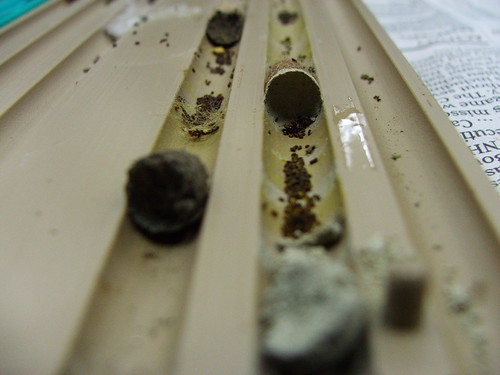
old mud plugs and mason bee feces
Mason bees are named after their ability to build out of clay and dirt. Here you can see bee-built mud plugs. The small black specks are bee feces.

beneficial wasp larvae
Here's a somewhat unusual sight. A female mason bee generally prefers long, narrow holes to make cocoons. Here she's built mud chambers, and you can see three cocoons. Wasps have also moved in--you can see the yellow wasp larvae. These wasps are a beneficial type and can be left undisturbed.
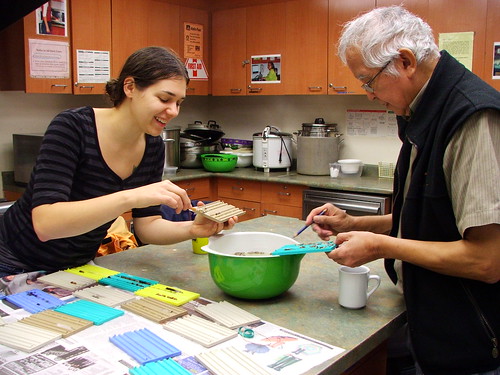
jessica and dave
Volunteers Jessica and Dave gently scrape bee cocoons into a cool water bath. We need to wash away any parasitic mites in several changes of water before storing the cocoons in a cool, safe place for the winter. Ideal places include unheated garages or a refrigerator.

In early spring we'll put the clean trays back in the houses, and put the cocoons out to hatch!

Friday, October 23, 2009

Health Canada and Bill C-6: Eliminating Cultural Wisdom & Free Choice in the Name of Consumer Safety

Drying herbs in your kitchen may soon be a crime. Under Bill C-6, the right to eat and to treat our bodies as we choose would be no more, as Health Canada will get more control in deciding which products are safe for the public. Having recently passed its second (out of three) readings in the Senate, Bill C-6 is the latest in a string of similar bills proposed by Health Canada to “help keep Canadian families safe from dangerous consumer products.”

But Bill C-6 is as much about consumer safety as drug companies are about actually healing people. Because natural ingredients are generally time-tested and have been used over generations precisely because they work, most haven’t undergone “rigorous scientific testing”. This bill aims do away with anything that hasn’t been approved in clinical trials, meaning vitamins and minerals, herbal remedies, and traditional medicines such as traditional Chinese medicines. Meanwhile, mass immunizations will be allowed to become mandatory, such as the flu shot, a drug which has been “proven safe” and contains antifreeze, the brain toxins mercury and aluminum, and formaldehyde which is used to preserve dead bodies.

As if that weren’t enough, Bill C-6 gives Health Canada inspectors the right to search for and seize unapproved products on people’s property without a warrant, which is otherwise required by the regular police force. Also under Bill C-6, a person is considered guilty until proven innocent –the opposite from normal court procedures. If natural health product companies don’t have the capacity to prove the safety of a “natural health product” through the scientific method, it will be a wonder for a regular person to do so.

Why is there hardly any coverage of this bill in the news? The intention is for it to be passed quietly without public awareness, and the next thing we know the supplements aisle has shrunk by 80 percent, a health inspector tramples onto our property in search of illegalibles, and a flu-shot needle is stabbed into our arm without our consent.

It boils down to that Bill C-6 violates Canadians' rights and freedoms, eradicating free choice and thousands of years of traditional cultural wisdom, and giving the industrial food and drug companies total domination of the marketplace. For those who would like to maintain their current level of independence in choosing what to consume, send an email to info@parl.gc.ca, call 1-866-599-4999, and/or write to:

The Senate of Canada,
Ottawa, Ontario,
K1A 0A4
(no postage required).

For a list of Senator’s email addresses, click here.

Tuesday, October 20, 2009

The Philosophy of Pig

for wayne
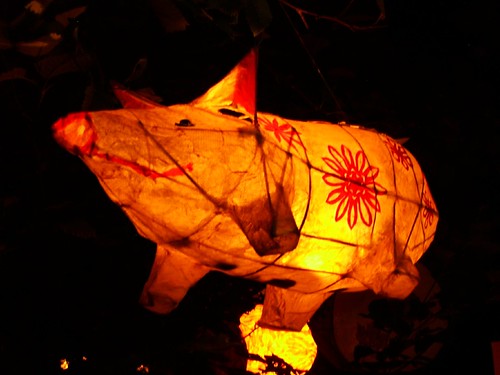
Pig! A colourful handmade paper lantern featured at the Renfrew Ravine Moon Festival.

Today CBC Radio's The Current aired an insightful documentary about saving heritage breeds of livestock that (like heirloom or heritage fruits and vegetables) were developed over many centuries. Many of these breeds have been abandoned for ones that are leaner, fatter, or faster to raise. Now they are in danger of extinction.

The documentary features a farming family whose pigs roam outside and get plenty of playtime and exercise. The pigs are free of hormones, steroids, antibiotics, growth stimulants or chemicals.

To learn more about the lives of small-scale Canadian farmers, or why it's important to save heritage livestock from extinction, you can listen to the 30 minute program here.

Friday, October 16, 2009

The Politics of Sugar: Feeding the Parasites

Sugar isn’t just bad for your teeth, the most influential substance in history after gold, and one of the most popular and delicious food ingredients. It’s also the favourite food of the parasites that live inside the human body. While researching sugar for a food security project, I found this fact the most intriguing, because it paints a disturbing picture for anyone who cares about food security and sovereignty.

Sugar in its most basic form -cane juice- isn’t harmful in and of itself. It’s when it’s processed into crystallized powdery stuff that it starts throwing off the human biology and becomes implicated in everything from inflammation, hypoglycemia, yeast overgrowth, a weakened immune system, hyperactivity, ADD, enlargement of the liver and kidneys, and mental and emotional disorders . There’s also corn syrup and other variations of highly refined sugars that the body doesn’t know how to process, so they become toxins floating around in the blood and ideal for parasites to feast on.

The largest supplier of sugary foods world-wide is the US, and the sugar industry lobbies to keep prices 2-3 times higher than the global market rate. A few people enrich themselves by producing a product that has no nutrients and is either the main ingredient or an additive in most supermarket or prepared foods. The stuff is so addictive that rats suffering from sugar withdrawal show many of the same behaviours as rats addicted to heroin and cocaine. With the average person consuming almost a cup of sugar each day, the grip sugar has on us as a society is near complete.

A person riddled with parasites may become irritable, tired, anxious, have constipation, diarrhea, gas and bloating, skin rashes, allergies, joint pain, sleep disturbances, low calcium or iron levels, immune dysfunction, and grind their teeth. When we go to the doctor, he or she will usually tell us to put cortisone on the skin, take arthritis medication, or that we have irritable bowel syndrome and should just eat regular meals. They’ll never tell us we have parasites unless we’ve recently visited a tropical country.

It’s in the interest of those in power to keep people addicted and downtrodden with the consequences of excessive sugar consumption, making boatloads of money and ensuring that we don’t think for ourselves. Therefore, it’s a good idea to cut back on the amount of sweets one eats, as well as check the ingredients of common foods for sugar or glucose/fructose and buy those with less chemically altered sugars like cane juice, agave nectar or honey. Because instead of feeding ourselves when we eat candy, soda, cookies, chocolate and pasta sauce with added sugar, we’re in all likelihood really feeding the sugar company daddies and our little intestinal “friends”.

Friday, October 9, 2009

FREE Food Security Events in the City

sheaves of wheat

For directions and information on more events, visit the main Sustenance site.
Bring an item for the FOOD BANK box and come on down!
SUSTENANCE: Feasting on Art & Culture festival
October 1-16 in Vancouver

FRIDAY, OCTOBER 9th at 6:30pm
EATING LOCALLY IN WINTER: MAKING THE BOUNTY LAST

FarmFolk/CityFolk will be discussing eating locally in the winter and handing out copies of their recently updated booklet, Eating Local in the Winter: Making the Bounty Last.
www.farmfolkcityfolk.ca

FRIDAY, OCTOBER 9TH at 7:00pm
PRESERVE THE HARVEST BY FERMENTATION - DEMONSTRATION

Join Radha Yoga & Eatery Chef Andrea Potter for a demonstration on fermenting Vegetables, an ancient culinary tradition. Unlike canning and using vinegar, pickling vegetables by fermenting them produces gut-friendly probiotic bacteria and enzymes. In this demonstration, you will discover how easy making homemade sauerkraut and brined pickles can be!

SATURDAY, OCTOBER 10th from 11am to 5pm
FAMILY DAY & PUMPKIN PIE CONTEST

Bring the whole family for lots of interactive fun! Starting with Growing Chefs interactive seed collages and more, our Pumpkin Pie Contest with Celebrity Judges Gourmet Warehouse owner Caren McSherry and Pastry Chef Merri Schwartz (Prizes for 1st, 2nd, and 3rdŠ First prize is 2 tickets to the 2010 Feast of Fields, valued at $190), followed by a reading from Alfalfabet and bean necklace making (for boys and girls!), then an interesting presentation (and delicious tastings) with Hardbite Chips owner Sepp Amsler, and almost last, but not least, join holistic nutritionist and founder of Seeds of Plenty, Tricia Sedgwick for a fun-filled workshop presentation about her creation of "The World in a Garden", a multicultural project with Jewish Family Service Agency. Enjoy an interactive learning session about the various ways different cultures celebrate the harvest season during a preview of their upcoming Multicultural Harvest Festival on October 18th. AND we will end the day with the breaking of a traditional Mexican star piñata!

TUESDAY, OCTOBER 13TH AT 3:00PM
YOUR DAILY BREAD: CONVENTIONAL AND ALTERNATIVE GRAIN CHAINS IN CANADA AND BRITISH COLUMBIA - WITH TERRA BREADS

Presented by Chris Hergemeiser who is leading FarmFolk/CityFolk's Grain Chain project and the new Urban Grains CSA. This year, an Agassiz garmer grew several types of wheat. 200 shares were sold at $90 each and they sold out within 3 weeks. The grain was just harvested and distributed last month. Chris will have his pedal powered mill and will be demonstrating how to mill wheat into flour via pedal power...and Terra Breads has baked some goodies with this locally grown wheat - just for this presentation.
http://www.urbangrains.ca
http://www.theflourpeddler.com
http://www.terrabreads.com


TUESDAY, OCTOBER 13TH AT 5:00pm
IT'S NOT JUST ABOUT FOOD, IT'S ABOUT JUST FOOD.

Join Chris Bodnar from Glen Valley Organic Farm (previously owned by Mayor Gregor Robertson) for a fun and informative workshop for individuals interested in social justice aspects of food. Much media attention to the local food movement has focused on food as a luxury item. But growing a local food system means more that fine dining; it must encompass access to food for people across socio-economic classes as well as fair wages for those growing the food.

TUESDAY, OCTOBER 13TH FROM 6:30PM TO 9:30PM
COOKING WORKSHOP WITH CHEF DARREN CLAY

Think global but COOK local is the theme for this class as we celebrate World Food Day. OK - This one is not free, but it's a great Cooking Class. For more information, visit http://www.roundhouse.ca and click on Classes & Workshops (browse by Date/Time Category: Culinary)

WEDNESDAY, OCTOBER 14TH AT 6:30pm
G.M. OGRE (STORYTELLING)

To all the adults out there, when is the last time anyone read YOU a fairy tale? Join author Erin Nichols for a reading of this adult fairy tale about greed and the importance of seeds where the Get More Ogre gets more than he expects.

WEDNESDAY, OCTOBER 14TH AT 8pm
TABLELAND, A FILM BY CRAIGN NOBLE

Join filmmaker Craig Noble for a screening of Tableland, a culinary expedition in search of the people, place and taste of North American small-scale, sustainable food production. From the Orchards of the interior of BC, the Napa Highlands, rural Quebec and everywhere in between, Tableland showcases the successful production of tasty, local, and seasonal food from field to plate. Suggested donation: $10
www.p1-productions.com

THURSDAY OCTOBER 15TH AT 7:00pm
OCEAN WISE & C RESTAURANT

Join Oceanwise's Mike McDermid and C Restaurant Executive Chef Robert Clark to learn about the world's marine life that is quickly being depleted. An estimated 90% of all large, predatory fish are already gone from the world's oceans. A recent scientific study predicted a world-wide fisheries collapse by 2048. The only solution is to turn back from the brink, and to begin consuming seafood in a sustainable manner. Chef Robert Clark will also be serving some sustainable seafood noche.
http://www.vanaqua.org/oceanwise
http://www.crestaurant.com


THURSDAY OCTOBER 15TH AT 8:00pm
SETTING THE TABLE FOR STORYTELLING

Join Jason McRobbie from Imagination Think (Jason is also the former editor of the BC Restaurant News) and Tomato Fresh Food Café owner Christian Gaudreault will for an interactive discussion about the changing nature of food writing focusing on editorial vision, new technologies and fundamental purpose. In a forum that has recently exploded with the rise of blogs and citizen-critique, professional food writing is defining its future beyond the fray - utilizing industry knowledge and relations combined with multi-medium messaging - to provide readers with a more interactive and meaningful taste of the good life. Tomato Fresh Food Café will be serving some regional tasty bites!
http://www.imaginationthink.com
http://www.tomatofreshfoodcafe.com


FRIDAY, OCTOBER 16th at 8pm
CLOSING CELEBRATION "WORLD FOOD DAY"

Join us for our Closing Celebration on World Food Day with Theatre on Earth's Pressure Cooker Cabaret, The Carnival Band, Rocky Mountain Flatbread Pizza and BEER!
www.thecarnivalband.com
Suggested donation: $10


Village Vancouver and Fork in the Road Events
(by donation)


Workshops on Tuesday, October 13th and Wednesday, October 14th with Robin Wheeler, on a variety of topics related to gardening, urban agriculture, food security, community, and sustainability -including one in partnership with WERA, the West End Residents Association.

Robin also kicks off VV's Cultivating Food, Cultivating Neighbourhoods series (in collaboration with Langara College Continuing Studies) on the 13th with a talk on Community Based Food Security.

Robin is the founder of The Sustainable Living Arts School and the author of Gardening for the Faint of Heart and Food Security for the Faint of Heart. She lives on the Sunshine Coast, and brings a vast wealth of knowledge and experience with her to each workshop.

Her workshops are always a real treat. You can expect your knowledge to expand and your soul to be delighted...and sometimes for your hands to get dirty.

We hope you'll join us!

Cheers,
Ross Moster
Village Vancouver

Tuesday, Oct 13th
Designing for Long Term Food Storage 9-10:30am


Cedar Cottage (near Victoria Dr., south of Trout Lake/John Hendry Park)
Food storage is missing from our modern habits and building design. We will discuss food preservation (tubers, grains, onions, etc. and how to choose locations for many food types so that appropriate storage areas can be created in apartments and houses. We'll also examine common problems and strategies to reduce waste.

Apartment and Container Gardening 1-2:30 pm
West End (location TBD)

co-sponsored by WERA, the West End Residents Assn. (with thanks to Green Millennium Foundation)

How to get more food from your balcony or patio. Space and weight are big problems for apartment dwellers. We will decide how to choose plants, discuss containers, soils, feeding and watering, succession planting and more in this workshop for small spaces.

Community Based Food Security 7-9 pm
South Cambie (at Langara College, 100 W 49th Ave.)

Individuals and families are scrambling to learn about and implement food security
techniques in their homes. But we have much more power as a group, and working
together as a community our capacity grows exponentially. Come and learn
the techniques of food security basics, plus ideas for sharing that will make you feel even more confident of food-based resilience. By donation. (Reg. #70816, see below.)

Wednesday, Oct 14th
Introduction to Medicine Making 9:15 am-12:15 pm


Potluck lunch follows for folks who would like to share a meal together
Main St./Little Mountain (near Cambie and King Ed)

There are so many plants that are safe, easy to recognize and locate, and effective. We will learn some recognition techniques, and then how to make teas, poultices, tinctures and infused oils. We'll learn about solvents, supplies and storage.

Seed Saving Primer 1:30-3 PM
Hastings Renfrew (near 1st and Nanaimo)


Seed saving is the missing link in food security. In our current political climate of seed patenting and ownership, it is increasingly important that a critical mass of a population have a good understanding of seed saving techniques. This will make it possible to create networks for seed abundance and resilience in many communities. This workshop will provide a deeper understanding of seed saving basics as well as provide time to discuss the implications of forming our relationships soon and well.

Your donation includes a copy of The Five Levels of Seed Saving by Terry Klokeid.

Shapes in Sharing 3:15-4:15 pm
Hastings Renfrew (near 1st and Nanaimo)

Ideas for sharing land, food, space and time with a workshop component. We'll do a study of our own assets and shortfalls and figure out how to equalize these on both a large and small scale.

All workshops are offered on a pay what you can basis. A one hour workshop usually costs around $10 to $15; a 1 1/2 hour workshop around $15 to $20; and a three hour workshop around $40. Our contributions to these workshops make it possible for teachers like Robin to expand and to deepen the scope of the important educational and social change work that they are involved in, particularly in these uncertain times.

Enrolment is limited to 20 people for each workshop. (15 for Apartment workshops.)


To register:
(or to find out more about hosting a future workshop), please contact Ross.

To register for programs in the Cultivating Food, Cultivating Neighbourhoods series,
please phone Langara College @ 604.323.5322. For further information: Leslie Kemp, 604.323.5981/ or www.langara.bc.ca.
*********

Cultivating Food, Cultivating Neighbourhoods series
Registration info above. All by donation, unless noted.

Tues, Oct 13 7-9 pm Community Based Food Security (70816)

Tues, Oct 27 7-9 pm Backyard Chickens 101 7-9 pm (70817)
Learn about the proper care and feeding of small urban flocks of hens. This interactive session will help participants discover the ease of caring for small flocks and allay fears and animosity about backyard hens.

Heather Havens is an agricultural and animal scientist who has worked to change the chicken bylaw in Vancouver. She legally imported her hens to Canada from the US in 2008.

Fri, Nov 13 6:30-9:30 pm Fork in the Road: Cultivating Food and Community in
& Sat, Nov 14 9:30 am-5 pm Local Neighbourhoods (70818)

Join us for an invigorating session using games and exercises to facilitate dialogue and inspire community based action on food issues.

Adam Ward, of Rhizome Theatre, has directed, hosted, and/or acted in more than 120 audience interactive events in the US and conducted Invisible Theatre happenings in the Netherlands, Canada and England.

$50/ $40 if registered by Oct 16

Tues, Nov 17 7-9 pm Neighbourhood Food Networking (70819)
Dialogue and take action on all the ways we can connect and provide support for one another around food and urban agriculture in our neighbourhoods.

Ross Moster, founder of Village Vancouver, is engaged in numerous projects around food, resiliency, and community building. He is a member of the Vancouver Food Policy Council and the Neighbours Organic Weekly Co-op board.

Series continues in 2010.

*********

Village Vancouver's food networking get togethers with Robin Wheeler and others are community based gatherings which help participants connect with others who share interests around food and sustainability on a neighbourhood level. Other presenters
include Spring Gillard (Diary of a Compost Hotline Operator) and Heather Havens (agricultural and animal scientist, Backyard Chickens 101).

These workshops are part of an ongoing VV series designed to help individuals, neighbourhoods, and communties learn how to live well using substantially less fossil fuels. We're a "transition" initiative, and are co-sponsoring Transition in Vancouver: from fossil fuel dependence to resilience at Langara College on December 4-5 from 9 am- 5pm. $195. (70815)

For further information: www.villagevancouver.ca or Welcome to Village Vancouver in Common Ground magazine www.commonground.ca. (June, July, and September)

The West End Residents Association (WERA) www.wera.bc.ca is an inclusive membership driven group seeking to improve and maintain quality of life for West End residents of Vancouver. Through education and advocacy we want to celebrate and encourage greater community voice, responsibility and empowerment. We believe that addressing issues of social equity and environmental sustainability will benefit everyone in the community. Among the issues that WERA addresses are transportation, community gardens, housing, pedestrian safety, and parks and recreation.

Thursday, October 8, 2009

Fall at the Food Security Institute

Dave with Pepa de Zapallo beans, a rare heirloom originally from Chile
First Nations Elder Dave poses with the heirloom beans he planted earlier this year.

Autumn is upon us! It's time to pull up eggplant and cucumber plants, plant garlic and fall rye, put away the irrigation hoses, and pickle all those green tomatoes. It's also time to bring the mason bees in out of the cold, sort and store heirloom beans and edible flower seeds (including calendula, borage, and sunflowers), and generally batten down the hatches for winter.

In the next two weeks, the Rooftop Garden Volunteer Team will be busily working on these and other tasks. If you're interested in helping out, let us know.

Pepa de Zapallo heirloom beans
Colourful pepa de zapallo heirlooms, a bean variety originally from Chile.

produce from the roof
Fresh tomatoes and eggplant from the roof. At a recent cooking workshop, we made two simple eggplant dishes with home-grown produce: Japanese-style grilled eggplant with sweet miso sauce, and Vietnamese-style roasted eggplant salad with fresh herbs and chilies.

volunteer team

flavoured sugar session
Food Security volunteers assembling jars of flavoured sugar to sell as a fundraiser.

chai spice
We'll miss you, Emily! Toronto is lucky to have you.

persimmon and fig trees in their temporary rooftop garden home
Persimmon and fig trees in their temporary spot on the Rooftop Garden (waiting to be planted at the Harvest Fair).

esther at the info booth
Esther at the information booth.

fundraiser sugar
Our flavoured sugars come with one easy sugar cookie recipe and some facts about sugar you might not have known. For example:

Sugar production supported the early Dutch, French, and English colonial empires. Sugar cane grew on slave plantations in the Caribbean and South America, helping to fuel the slave trade with Africa. Cotton and tobacco slave plantations in the American South were modeled after 17th century British sugarcane plantations.

In 2009, Canadian company Rogers Sugar began growing genetically modified sugar beets in Alberta, despite over 4000 concerned emails and letters from consumers. Now Rogers will be selling genetically modified sugar made from the beets.

windermere volunteers at the harvest contest table
Windermere volunteers at the Harvest Competition table. Pictured: winning entry for the Biggest Sunflower category.


Winning entry for "biggest zucchini" (Photo courtesy Youth Media


Tammy explains the Harvest Competition (Photo courtesy Youth Media.


Coming soon: The Tree Planting Story and photos, safe canning tips, the death and times of Norman Borlaug.

Friday, October 2, 2009

Reminder: Harvest Fair and Moon Festival October 3

assorted heirloom tomatoes
It’s getting very exciting around here! The costumes are all done (almost), new lanterns are finished and favourites from previous years are repaired and ready to go. Now it’s the last minute details of final rehearsals, shopping lists and excited calls from artists with last minute inspirations and questions. Great performers are coming! check it out!

4-7 pm Harvest Fair artists include:

Zeellia singing Slavic Soul Music
the Wheeling eights square dance club
A-Slam punjabi live hip hop music
BC Clettes, bicycles dancers

7:00 pm Lanterns, music and art by the stream in Renfrew Park.

Live music by
Twisted Strings – Random Acts of Violins
Aligator Joy Gamelan ensemble
Lisa Chase – singer songwriter
Jun Rong- erhu
Violin Chapeau – classical violin duo
Marimbamaphone interactive instrument

Performance Art
Mind of a Snail shadow puppet theatre
True North – Upaya, with an Evelyn Roth inflatable

Lantern Installations
By:
Nicole Dextra
Yoko Tomita
Carmen Rosen
Joey Mallett
Naomi Singer
and many many more

8:30pm finale spectacle on Renfrew Park field
Big band, original music, dance, fire spinning and fireworks
Original Music by Brad Muirhead and the Renfrew Community Performance Project band
Original dance, stilt dance and fire spinning by Isaac Rosen-Purcell, Odette Slater, Ariel
Anderson and 25 young performers from the community.

See you there!