City staff have been finalizing proposed bylaw recommendations, so backyard chickens may be legal in Vancouver very soon.
Village Vancouver and Fork in the Road are presenting 2 neighbourhood Backyard Chickens 101 learning parties with Heather Havens on Sunday, October 4th by donation. A 3rd workshop will be added if there is enough interest.
Main St/Little Mountain: near Cambie and King Ed from 10-noon (Potluck to 1);
Dunbar: near Dunbar and 18th from 1:30-3:30.
Learn about the proper care and keeping of small urban flocks of hens and meet neighbours who share your interest. This interactive session will help participants discover the ease of caring for small flocks and ally fears and animosity about backyard hens.
Heather Havens is an agricultural and animal scientist. In January, 2008, she legally imported her hens to Canada and has since worked with others to help the Vancouver City Council change the backyard chicken bylaw. Heather taught the first local backyard chicken keeping workshop in Richmond BC in Feb 2009, and Village Vancouver organized the 1st workshop in Vancouver at Langara College in June.
To register email Ross. Everyone is welcome, but registration is limited to 15-20 people per workshop.
Cheers,
Ross Moster
Village Vancouver
Village Vancouver organizes neighbourhood food growing/sharing skills learning workshops with Heather, Robin Wheeler (founder Sustainable Living Arts School-Roberts Creek, author Gardening for the Faint of Heart, and Food Security for the Faint of Heart), Spring Gillard (Diary of a Compost Hotline Operator), and others. Next workshops: Robin Wheeler Sept 29-30 and Oct 13-14. New hosts welcome.
Our learning parties are part of an ongoing series which is designed to help individuals, neighbourhoods, and communities learn how to live well (and have more fun!) while using substantially less fossil fuels.
Upcoming Village Vancouver Programs
Langara College
Oct 7 Wed Shifting from Knowing to Doing class. 6-8 pm (Philip Be'er)
Oct 8 Thur Overshoot: Human Enterprise and Natural Law. 7-8:30 pm (Rex Wyler)
Oct 13 (Wed) and 27 (Wed), Nov 13/14 (Fri/Sat) and 17 (Wed), and Jan/Mar
Cultivating Food, Cultivating Neighbourhoods, an 8 part series, which includes Fork in the Road: Cultivating Food and Community in Local Neighbourhoods on Nov 13-14
Oct 21 Wed Greening Your Living Space: Practical Ways to Reduce Energy Consumption in Your Home or Building 6-9pm (Philip Be'er)
Dec 4/5 Fri/Sat Transition Town Transition for Vancouver workshop. 9am-5pm (Michelle Colussi and David Johnson) Highly recommended! For info on TT's: www.transitiontowns.org.)
Cornucopia
An interactive display wihich examines the industrialization of the food system and local solutions to it, premiers as part of the Sustenance: Feasting on Art and Culture Festival Oct 1-16 at the Roundhouse.
For further information on our programs, or to learn more about Village Vancouver, please contact Ross, or visit www.villagevancouver.ca or Welcome to Village Vancouver in Common Ground magazine www.commonground.ca (June, July, and September). Our learning parties are inspired in part by the Sustainable Living Arts School Vancouver learning parties. slas.ca.

Wednesday, September 30, 2009

Tuesday, September 29, 2009
Why Ancient Wisdom Matters in the Modern World

[Rooftop Garden volunteer Tim shares Aboriginal planting traditions, spring 2009.].
The Wayfinders.
Recently, many of us have been alarmed to learn of accelerating rates of extinction among plants and animals on our planet. But how many of us know that human cultures are going extinct at an even more shocking rate? While biologists estimate that 18 percent of mammals and 11 percent of birds are threatened, and botanists anticipate the loss of 8 percent of flora, anthropologists predict that fully 50 percent of the 7,000 languages spoken around the world today will disappear within our lifetimes. And languages are merely the canaries in the coalmine: what of the knowledge, stories, songs, and ways of seeing encoded in these disappearing voices?
In The Wayfinders, Wade Davis offers a gripping and enlightening account of this urgent crisis. He leads us on a fascinating tour through a handful of indigenous cultures, describing the worldviews they represent and reminding us of the encroaching danger to humankind’s survival should they disappear.
Wade Davis is a noted Canadian anthropologist, ethnobotanist, author, and photographer whose work focuses on indigenous cultures worldwide, particularly involving traditional uses and beliefs associated with plants.
For more information, please visit the CBC's Massey Lectures website.
Tuesday, September 22, 2009
How to Boil a Frog, Food Justice Forum & Volunteer Orientation

In preparation for the upcoming Harvest Fair and Moon Festival, we'll be putting together food-related crafts to sell as a fundraiser. Help us promote deliciousness while also raising awareness about the politics of sugar. Bring old (clean) glass jars if you can spare them.
Tuesday September 29
4:30-6:30
Collingwood Neighbourhood House (5288 Joyce St., Vancouver)
For those of you who have expressed interest in volunteering at the Food Security Institute, this will be a good opportunity to meet other volunteers, ask questions, and find out about our many initiatives. I hope you'll be able to join us.
RSVP by email or by phone at 604.435.0323.
How to Boil a Frog
How to Boil a Frog is an eco-comedy (documentary feature film) that mixes rapid-fire humour with hard-hitting facts to show the consequences of “overshoot” – too many people using up too little planet – and what it means for our future. With its upfront Everyman approach, world-class experts, and iconoclastic humor, How to Boil a Frog gives us the scoop on the imminent end of the world as we know it and 5 surprising ways that regular people like can save civilization, while making our own lives better now.
Film: How to Boil a Frog
Date: Wednesday, Sept 23
Time: 7:00 pm
Location: Langara College, Theatre A130
Food Justice Forum (part of SUSTENANCE)
Why is organic, sustainably produced food unaffordable for many people? Can we pay the real cost of food, while also providing quality food at an affordable price? Is there a need for low-cost food options, including fast food, in our community? Join the panel of speakers for a discussion of these questions and more.
Joyce Rock, Director, Downtown Eastside Neighbourhood House and food access advocate
Chris Bodnar, Glen Valley Organic farmer and food sustainability activist
Barbara Joughin, Co-author of the Vancouver Food Charter
Moderated by Sandra Thomas from the Vancouver Courier
Date: Thursday October 8
Time: 7 - 9pm
Location: Britannia Community Centre, Learning Resource Centre
This is a free event
Fork in the Road: Cultivating Food and Community in Local Neighbourhoods
This is a 1 1/2 day gathering organized by Village Vancouver members. They use fun games and exercises to explore "What would happen if we made a conscious effort to create neighbour based food growing/sharing networks in our neighbourhoods and communities?" Fork participants have also been known to get together for potlucks where they share nourishing food, information and resources.
Date: Friday Nov. 13th and Saturday Nov. 14th
Location: Langara College
For times and information contact: Leslie Kemp.
PS--here is an online video on food policy in the USA. GMO labelling, organics etc. It's about 40 minutes long. Enjoy!
Monday, September 21, 2009
A Quick History of Home Canning
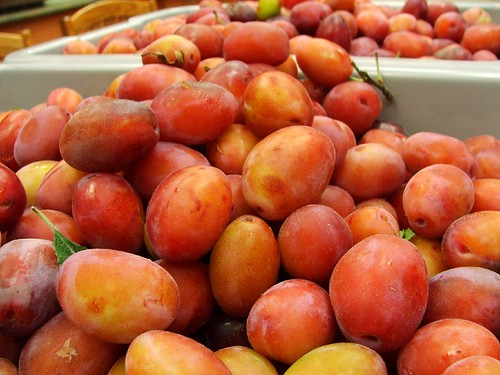
Some of the 125lbs of plums donated to our programs from the nice people at The Vancouver Fruit Tree Project.
Modern canning (including the dazzling selection of canned goods and bottled sauces found at your local grocery store) represents thousands of years of human ingenuity. Since prehistoric times, our ancestors have been trying to preserve surplus food for hungry times ahead. Some of the techniques humans have developed include: drying, smoking, or freezing in ice or snow.
In 1795, the French government offered a prize to anyone who could invent an improved method of preserving food. Nicolas Appert won the prize by packing fruits, vegetables, and meats into glass bottles without air and processing the bottles in boiling water.
For the next 6 decades or so, people experimented with different canning methods and materials (such as lead and tin). Some of these experimental canning methods were difficult, expensive, or unsafe. Bacteria was not understood well, and contamination was common. Illnesses and even death could result from eating canned goods.
In 1858, a 26-year-old American named John L. Mason invented the mason jar. This was a glass jar with a resealable metal lid. Mason's invention made home canning relatively safe, as the jars had durable vacuum seals to trap out bacteria. The inexpensive screw-on lids made the jars truly reusable--and revolutionized the home canning process.
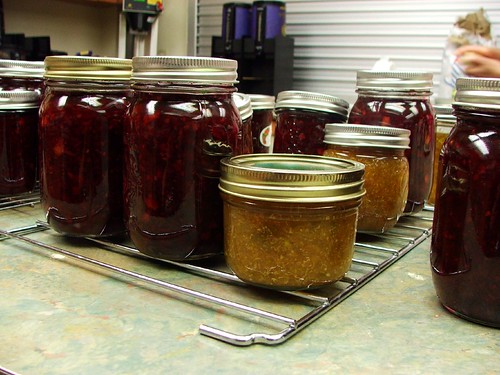
Wild blackberry-Asian pear jam and fig jam in modern mason jars.
The mason jar was invented around the time that inexpensive sugar became widely available in the United States. Thus, for the first time, the average homemaker was able to preserve seasonal bounty for use through the hungry winter and early spring. Home canning improved nutrition and meal variety, even for those who were not wealthy.
The mason jars we use today have not changed very much since John Mason's time. However, there have been several refinements around the canning process; scientific research and data collection has allowed us to understand the risks of home canning better than in the past. Some traditional family recipes or methods are not recommended for use today. We'll talk about these issues in a blog post on "Tips for Successful Canning," coming soon.
Home canning skills were once extremely common--but on the market today, we find many safe and inexpensive commercial canned goods. Some of these products contain a lot of salt or chemical preservatives--but they are so convenient that most busy urban folks have forgotten home to can food at home.
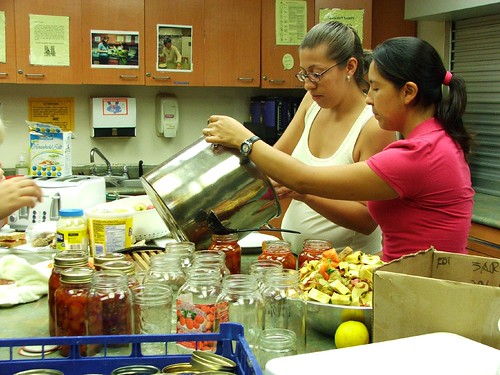
Liliana and Mirabel ladling plum preserves into hot sterilized jars.
Lately, the Food Security Institute has been receiving large donations of surplus fruit from generous local residents and Collingwood Neighbourhood House employees. We have received more than 200 pounds of fresh plums, as well as figs, apples, Asian pears, and (Western) pears. This fruit has distributed directly to families who having a hard time financially, or it is used in our many different food programs.
This overwhelming generosity has also underlined the importance of extending the season's bounty through the winter months. Even with all of our food programs, how can we use up so much fruit before it goes bad? We hate to see food go to waste so...
Using donated fruit as well as donated mason jars, we have been sharing food preservation skills and stories at canning workshops. The workshops are part of the Farmers' Market Nutrition Coupon Program, and priority for registration is for Coupon Program participants. Still, there is sometimes space left over, and interested people should contact me for scheduling information and to join us.
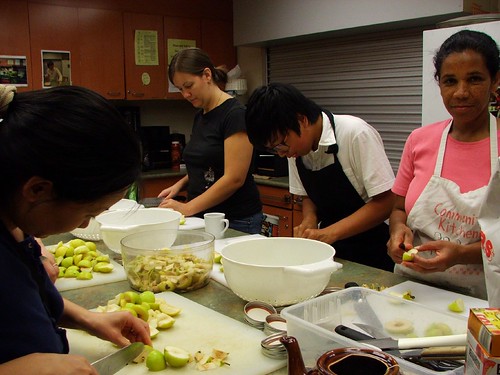
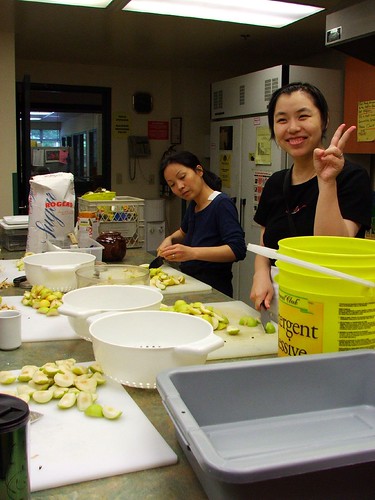
Preparing Asian pears for preserving.
While busily coring, peeling, and slicing, participants have been sharing memories of canning fruits and vegetables. Some participants made canned goods with their parents or grandparents, and some used different food preservation methods in their countries of origin.
This season's bounty has given us the opportunity to share stories and skills, and to extend the harvest to others beyond the canning workshops. For example, some of the preserves and sauces we've made have been used in the community lunch program as well as the Morning Star breakfast program. Volunteers at the lunch program served perogies with our "homemade" blueberry-apple sauce--it was a big hit with the seniors.
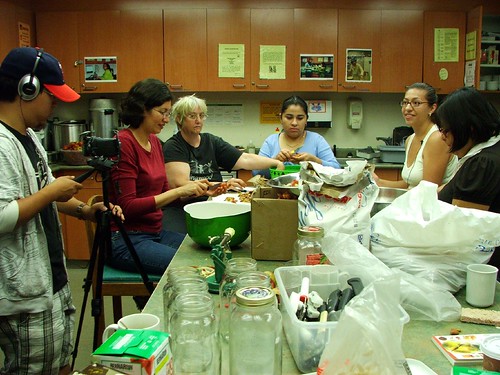
Program participants relate their experiences in the Farmers' Market Nutrition Coupon Project to visiting filmmakers from the Environmental Youth Alliance. You can watch the short documentary Nourishing Stories at the upcoming SUSTENANCE Festival.
The historical information in this post is taken from The Oxford Companion to American Food and Drink (2007), edited by Andrew F. Smith. Drawing from this and other sources, we'll be addressing some frequently asked questions about home-canning in an upcoming post. We'll also be offering important safety and seasoning tips for successful canning.
Do you have surplus backyard fruit, or know someone who does? Please contact the volunteers at The Vancouver Fruit Tree Project. Hopefully, some of your fruit can be donated to a charitable organization near you.
Thanks, and happy eating!
Friday, September 18, 2009
Fields of Plenty
Michael Ableman, farmer and celebrated author of "Fields of Plenty", is coming to Centennial Theatre in North Vancouver on Wednesday, October 21, 2009 at 7:30pm to speak on Feeding the Future: Stories and Images from the New Frontier of Food and Agriculture.
Michael will inspire us with his stories and powerful photographic images of people from around the world who are using community land, backyard gardens as well as urban farms for creating socially and ecologically sustainable ways of growing food. He will show us the potential for our region and even our mountainous North Shore. Be inspired by his stunning photography and reflections on the intersection between food, culture and sustainability from around the world.
A great presentation for children and youth interested in stewardship and sustainability!
Tickets: $10, available from the Centennial Theatre Box Office at 604-984-4484 or www.centennialtheatre.com . Tickets available for those with financial barriers.
For more information please go to www.ediblegardenproject.com. For tickets call Centennial Theatre at 604-984-4484. Poster attached.
Presented by Vancouver Coastal Health (North Shore), North Shore Neighbourhood House and the Edible Garden Project.
Michael will inspire us with his stories and powerful photographic images of people from around the world who are using community land, backyard gardens as well as urban farms for creating socially and ecologically sustainable ways of growing food. He will show us the potential for our region and even our mountainous North Shore. Be inspired by his stunning photography and reflections on the intersection between food, culture and sustainability from around the world.
A great presentation for children and youth interested in stewardship and sustainability!
Tickets: $10, available from the Centennial Theatre Box Office at 604-984-4484 or www.centennialtheatre.com . Tickets available for those with financial barriers.
For more information please go to www.ediblegardenproject.com. For tickets call Centennial Theatre at 604-984-4484. Poster attached.
Presented by Vancouver Coastal Health (North Shore), North Shore Neighbourhood House and the Edible Garden Project.
Wednesday, September 16, 2009
Two Upcoming Food Security Workshops
Food Security Primer with Robin Wheeler
Saturday September 19, 10:00am-12:30pm
and
Saturday September 19, 2:00pm-4:30pm
UBC Farm is booking two identical workshops because they are going to fill up fast!~
Course description:
This 2.5 hour workshop was designed to lead the individual to a place of greater resilience and resourcefulness, so they can then move into community based work. We will discuss stockpiling, gleaning, working with farms, food preservation, reducing waste, intensive growing practices, community sharing and more. Food security starts with the individual.
Date: Saturday September 19: 10am-12:30pm OR 2:00pm-4:30pm
Cost: $24 (plus $1.75 cent registration fee)
Registration:
Limited to 20 people. Please register for the Morning Workshop here. Please register for the Afternoon Workshop here.
**Please note that all UBC Farm Growing Season Workshops require advance payment. Also, our workshops sell out VERY quickly. We apologize for any inconvenience or disappointment. There is great demand for our workshops, and unfortunately we can't accomodate everyone. If the website says the workshop is full, it really is full.**
Presenter Bio: Robin Wheeler is author of Food Security for the Faint of Heart. She has been actively supporting local agricultural for over 15 years. She operates Edible Landscapes, a plant nursery, and uses her property as a teaching garden for the Sustainable Living Arts School in Roberts Creek, BC. She is founder of the One Straw Society and is also author of Gardening for the Faint of Heart.
What to Bring: Pen, paper
Growing Season Workshops
This event is part of the UBC Farm Growing Season Workshop Series. Our goal is to connect sustainability and life-skills experts with our local community through accessible and affordable workshops. Come join us for a workshop, gain new skills and knowledge, and help support the UBC Farm!
Special Request:
Our presenter Robin is looking for a ride to the Farm from Kitsilano for the 10am workshop. If you are registered for the workshop and you are able to offer her a ride please email Sarah at: ubcfarm.interns@gmail.com - we'll be sending you home with a lovely bouquet of flowers!
Season-extension and winterizing strategies for the farm and garden with Delisa Lewis!
Monday September 21, 5-7pm
Course description: Celebrate the equinox at the UBC farm! Get some experience and join the conversation on season extension and winterizing strategies for your small farm or garden. We'll use on-farm examples of season extension to launch our discussion of topics ranging from cover crops, fabric row covers, mulching, composts, and regional variety selection for over-wintering. With the cooperation of the farm team and favorable weather, we plan to take on a small scale, hands-on winterizing project out in the fields.
Date: Monday Sept 21, (5-7pm)
Cost: $20 (plus $1.65 cent registration fee)
Registration: Limited to 20 people. Register on-line HERE. **Please note that all UBC Farm Growing Season Workshops require advance payment. Also, our workshops sell out VERY quickly. We apologize for any inconvenience or disappointment. There is great demand for our workshops, and unfortunately we can't accomodate everyone. If the website says the workshop is full, it really is full.**
Presenter Bio: Delisa Lewis came to BC from the USA after many years as a small scale organic farmer and educator. Delisa is passionate not only about growing delicious, healthy food, but also about growing new growers. Delisa likes driving tractors very much and is currently a Phd Candidate in the Faculty of Land and Food Systems.
What to Bring: Pen, paper, appropriate clothing for working outside
Growing Season Workshops: This event is part of the UBC Farm Growing Season Workshop Series. Our goal is to connect sustainability and life-skills experts with our local community through accessible and affordable workshops. Come join us for a workshop, gain new skills and knowledge, and help support the UBC Farm!
Saturday September 19, 10:00am-12:30pm
and
Saturday September 19, 2:00pm-4:30pm
UBC Farm is booking two identical workshops because they are going to fill up fast!~
Course description:
This 2.5 hour workshop was designed to lead the individual to a place of greater resilience and resourcefulness, so they can then move into community based work. We will discuss stockpiling, gleaning, working with farms, food preservation, reducing waste, intensive growing practices, community sharing and more. Food security starts with the individual.
Date: Saturday September 19: 10am-12:30pm OR 2:00pm-4:30pm
Cost: $24 (plus $1.75 cent registration fee)
Registration:
Limited to 20 people. Please register for the Morning Workshop here. Please register for the Afternoon Workshop here.
**Please note that all UBC Farm Growing Season Workshops require advance payment. Also, our workshops sell out VERY quickly. We apologize for any inconvenience or disappointment. There is great demand for our workshops, and unfortunately we can't accomodate everyone. If the website says the workshop is full, it really is full.**
Presenter Bio: Robin Wheeler is author of Food Security for the Faint of Heart. She has been actively supporting local agricultural for over 15 years. She operates Edible Landscapes, a plant nursery, and uses her property as a teaching garden for the Sustainable Living Arts School in Roberts Creek, BC. She is founder of the One Straw Society and is also author of Gardening for the Faint of Heart.
What to Bring: Pen, paper
Growing Season Workshops
This event is part of the UBC Farm Growing Season Workshop Series. Our goal is to connect sustainability and life-skills experts with our local community through accessible and affordable workshops. Come join us for a workshop, gain new skills and knowledge, and help support the UBC Farm!
Special Request:
Our presenter Robin is looking for a ride to the Farm from Kitsilano for the 10am workshop. If you are registered for the workshop and you are able to offer her a ride please email Sarah at: ubcfarm.interns@gmail.com - we'll be sending you home with a lovely bouquet of flowers!
Season-extension and winterizing strategies for the farm and garden with Delisa Lewis!
Monday September 21, 5-7pm
Course description: Celebrate the equinox at the UBC farm! Get some experience and join the conversation on season extension and winterizing strategies for your small farm or garden. We'll use on-farm examples of season extension to launch our discussion of topics ranging from cover crops, fabric row covers, mulching, composts, and regional variety selection for over-wintering. With the cooperation of the farm team and favorable weather, we plan to take on a small scale, hands-on winterizing project out in the fields.
Date: Monday Sept 21, (5-7pm)
Cost: $20 (plus $1.65 cent registration fee)
Registration: Limited to 20 people. Register on-line HERE. **Please note that all UBC Farm Growing Season Workshops require advance payment. Also, our workshops sell out VERY quickly. We apologize for any inconvenience or disappointment. There is great demand for our workshops, and unfortunately we can't accomodate everyone. If the website says the workshop is full, it really is full.**
Presenter Bio: Delisa Lewis came to BC from the USA after many years as a small scale organic farmer and educator. Delisa is passionate not only about growing delicious, healthy food, but also about growing new growers. Delisa likes driving tractors very much and is currently a Phd Candidate in the Faculty of Land and Food Systems.
What to Bring: Pen, paper, appropriate clothing for working outside
Growing Season Workshops: This event is part of the UBC Farm Growing Season Workshop Series. Our goal is to connect sustainability and life-skills experts with our local community through accessible and affordable workshops. Come join us for a workshop, gain new skills and knowledge, and help support the UBC Farm!
Wednesday, September 9, 2009
September 10: Winter Gardening Workshop

Did you ever wonder what you can plant in the autumn or winter? If you would like to extend the harvest into the winter and early spring (or you were distracted earlier in the year and THOUGHT it was too late to plant anything):
Autumn and Winter Planting Workshop
Thursday, September 10th 7-8:45pm.
Collingwood Neighbourhood House (5288 Joyce St.), Rooftop Garden and Staff Lounge
RSVP.
This month’s guest speaker is Arzeena Hamir, Coordinator of the Richmond Food Security Society.
The Renfrew Collingwood Garden Club meets every second Thursday of the month from 7-8:45. It’s a place for gardeners to meet other gardeners--for workshops, film nights, talking circles, healthy snacks, and building community through food-growing. You are welcome to bring a potluck snack and a friend; we bring the tea and coffee.
Tuesday, September 8, 2009
Harvest Fair and SUSTENANCE

The schedule for SUSTENANCE is now available! We strongly recommend checking out what's going to be a diverse, eye-opening, and family-friendly festival.
We are very excited that some of our Farmers' Market Nutrition Coupon Program participants will be featured in the Environmental Youth Alliance's Nourishing Stories short documentary. Nourishing Stories will play at The Roundhouse from October 1-16.
Our very own Harvest Fair will be one of many SUSTENANCE activities taking place across Vancouver. For information about Harvest Fair activities and contests, click the image below to view the poster.
All competing entries should be brought to Slocan Park by 4:30pm on the day of the Fair.
A special note for Photo Contestants
Photo contestants can either take their entries home after the Fair, or give permission for the image to be printed in a limited edition set of postcards. The postcards will be sold during the Winter Craft Fair at Collingwood Neighbourhood House. The sale will help raise funds for Food Security activities and help promote local photographers and their work. Photographers will have full credit and will retain all rights over the images.

Lost Streams Walks
The False Creek Watershed Society presents the 2nd annual:
LOST STREAMS Walks
for September as “Wild Salmon Month” in Vancouver
Sept 12 – Musqueam Creek – Vancouver’s last wild salmon stream - walk with Terry Point
Sept 13 – Gibby's Field – part of China Creek's once-vast system – walk with Dan Fass
Sept 19 – Tatlow and Macdonald Creek – from wild native creek to cityscape – walk with Bruce Macdonald
Sept 19 – Lake at the Head Creek – Dunbar's wild coho heritage – walk with Terry Slack
Sept 20 – Vancover's Last Steelhead Run – walk with Terry Slack
Sept 26 – False Creek Seawall to Senakw – walk with Chief Bill Williams
LOST STREAMS Walks
for September as “Wild Salmon Month” in Vancouver
Sept 12 – Musqueam Creek – Vancouver’s last wild salmon stream - walk with Terry Point
Sept 13 – Gibby's Field – part of China Creek's once-vast system – walk with Dan Fass
Sept 19 – Tatlow and Macdonald Creek – from wild native creek to cityscape – walk with Bruce Macdonald
Sept 19 – Lake at the Head Creek – Dunbar's wild coho heritage – walk with Terry Slack
Sept 20 – Vancover's Last Steelhead Run – walk with Terry Slack
Sept 26 – False Creek Seawall to Senakw – walk with Chief Bill Williams
Friday, September 4, 2009
2009 Blackberry Festival is Cancelled
Unfortunately due to conflicting time commitments and schedules, we were not able to host a Blackberry Festival this year. We look forward to resuming this tradition next summer.
In the meantime, your assistance is needed to preserve large amounts of garden fresh fruit that is being donated to our initiatives. Thanks to local residents and participants, we have made vanilla-scented fig preserves and wild blackberry-Asian pear jam. Coming soon: plum preserves, pear jam, canned tomatoes, applesauce, and more!
Upcoming Food Events
6th Annual Corn Festival
Come try delicious traditional Latin American food made with corn. Music, presentations and more!
Everyone Welcome
Sunday Sept 6th, 1 - 6pm
Britannia Community Centre
Gym D
For more info call 778-385-5394
Youth Environmental Film Screening
Come out and watch 3 short films created by participants in EYA's youth summer film intensive. Space is limited, R.S.V.P to Samantha.
Monday September 7th, 8:00 p.m. Strathcona Eco-Pavilion at Hawks and Prior.
Living Wall Community Installation and Celebration
Tuesday, September 22nd come and assist with the installation of a living wall in Blood Alley and join in on the festivities as well. RSVP to Rhianna.
Mount Pleasant Harvest Festival
Saturday, September 26th from 11-4, come to the Mount Pleasant Neighbourhood House at Prince Albert and Broadway for an afternoon of community fun!
In the meantime, your assistance is needed to preserve large amounts of garden fresh fruit that is being donated to our initiatives. Thanks to local residents and participants, we have made vanilla-scented fig preserves and wild blackberry-Asian pear jam. Coming soon: plum preserves, pear jam, canned tomatoes, applesauce, and more!
Upcoming Food Events
6th Annual Corn Festival
Come try delicious traditional Latin American food made with corn. Music, presentations and more!
Everyone Welcome
Sunday Sept 6th, 1 - 6pm
Britannia Community Centre
Gym D
For more info call 778-385-5394
Youth Environmental Film Screening
Come out and watch 3 short films created by participants in EYA's youth summer film intensive. Space is limited, R.S.V.P to Samantha.
Monday September 7th, 8:00 p.m. Strathcona Eco-Pavilion at Hawks and Prior.
Living Wall Community Installation and Celebration
Tuesday, September 22nd come and assist with the installation of a living wall in Blood Alley and join in on the festivities as well. RSVP to Rhianna.
Mount Pleasant Harvest Festival
Saturday, September 26th from 11-4, come to the Mount Pleasant Neighbourhood House at Prince Albert and Broadway for an afternoon of community fun!
Thursday, September 3, 2009
Scenes from the Rooftop Garden
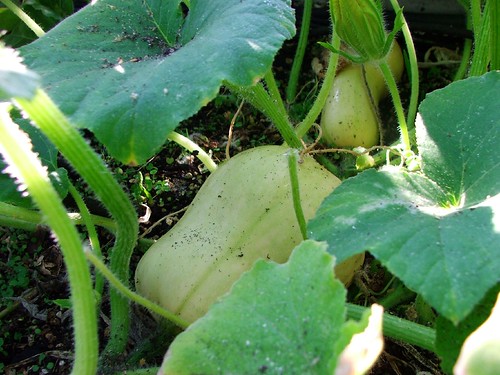
Several butternut squash vines "volunteered" in the garden. This is likely because our vermicompost bins didn't generate enough heat to destroy the germination potential of composted seeds. Volunteer plants can be lovely surprises, but can also overwhelm the garden...undesired volunteers make great gifts or sale items at fundraisers.
Dear Readers,
The irrigation system is fixed and the garden is still thriving, thanks in huge part to our great team of dedicated volunteers! Due to a moth infestation in the storage area, we had to throw away many of the seeds we were saving for next year, so will be doing lots of seed saving activities through the fall.
Planting of winter crops is underway, and you should definitely contact us if you would like to join in. New gardeners of all skill levels are always welcome.
We're also gearing up for the annual Harvest Fair, part of the Renfrew Ravine Moon Festival.
This year, the Harvest Fair is also partnering with SUSTENANCE: Feasting on Art & Culture Festival, a unique celebration that culminates on World Food Day (October 16th).
Other SUSTENANCE community partners include our friends at the Grandview Woodlands Food Connections and the Trout Lake Cedar Cottage Food Security Network.
To learn more about Sustenance, take a look here. Big thanks to the folks at The Roundhouse for bringing us all together for a common cause.
We hope you enjoy these snapshots from the garden.

Grape vines bearing in their second year. We may not have many grapes this year, but we will have lovely dolmades at an upcoming community kitchen.

Assorted heirloom carrots planted by the Families Branching Out group are ready for eating.

These spicy oregano flowers have been extremely popular with honeybees throughout the summer.

We have two kinds of eggplant growing on the roof this year, "ichiban" and "lavender."


Yellow brandywine tomatoes as big as softballs. These are a late-maturing variety but well worth the wait. Yellow tomatoes have a lower acid content than red and black tomatoes, and can be a good solution for people who get upset stomachs from eating acidic red tomatoes. Acidity content in common garden vegetables will be addressed in an upcoming post on fall canning techniques.


Japanese black trifele tomatoes leaves have a "potato leaf" shape. Due to differences in flower shape, potato leaf varieties are more likely to cross-pollinate with other kinds of tomatoes.

Speckled roman tomatoes at two stages of ripeness:


Jerusalem artichokes (or Sunchokes) are not related to artichokes and are not from Jerusalem! They are a kind of sunflower grown specifically for tasty, edible roots. They are very easy to grow.

These sunchoke roots look a bit like ginger rhizomes. They can be cooked and eaten like other root vegetables. Try substituting sunchokes for potatoes in roasted vegetables or a root vegetable mash.

As always, the Garden is an oasis from the buzz of the city below. Here, young community kitchen participants dig into a Salvadorian-themed meal.
Subscribe to:
Posts (Atom)