Renfrew Collingwood Food Security Institute: July 2009

Wednesday, July 29, 2009

The Farmers' Market Nutrition Coupon Project

cherry pie filling; strawberry rhubarb pie

Among our many goings-on here at the Food Security Institute, we have now added another weekly program. The Renfrew Collingwood Food Security Institute is pleased to be one of several sites for the 2009 Farmers’ Market Nutrition and Coupon Project. This innovative program is a provincial initiative of the BC Association of Farmers Markets. The program is aimed at low-income pregnant women, and low-income parents of young children. Families in the program attend a series of classes and workshops that teach cooking and nutrition skills. They also receive weekly coupons to be used at their local farmers’ markets, giving them access to fresh, nutritious, locally grown fruits, vegetables, meats, eggs, or dairy products.

lasagna


At the Food Security Institute, many of the weekly classes we are running as part of this project are taught by community volunteers. Two weeks ago, the class was presented by Barry, a retired chef who lives in the Collingwood neighbourhood. Under Barry’s expert guidance, program participants learned to make fresh pesto sauce, and simple ways to prepare fresh seasonal vegetables, such as carrots and beets. Did you know that the leafy, green tops of beets are not only edible, but highly tasty? Barry showed us how to cook beet greens for a few minutes with a bit of butter, nutmeg, salt and pepper, and the results were delicious.

Last week’s class was taught by Emily, an avid volunteer at the Food Security Institute. Emily works in a bakery, and she was taught participants how to bake several types of bread. Many of the program participants are recent immigrants from Spanish-speaking countries, and Emily happens to speak Spanish. Emily’s workshop was our first bilingual presentation in this program (but hopefully not the last!)


So far the Farmers Market Coupon Project has been fun, educational, and provided opportunities for both nutrition skill-building and increased social connections for participants. We are looking forward to future workshops on salmon canning, blackberry jam preserving, vegetarian cooking, and more!

Sunday, July 26, 2009

$1 zucchini the size of your torso, one day special!

Collingwood Multicultural Summer Market

Here are some photos of the first Collingwood Multicultural Summer Market, which is part of the City of Vancouver's Summer Spaces initiative.

The first of five Sunday markets, the July 26 event featured delicious local produce from family-run business Sandhu Produce Growers, henna art, an international spice market and recipe trading post, a free bicycle repair station (staffed by local volunteers Rob and Scott), and tasty prepared food from local restaurants.

We hope you'll be able to join us next Sunday from 10-2 on Vanness Avenue just west of Joyce Skytrain Station!

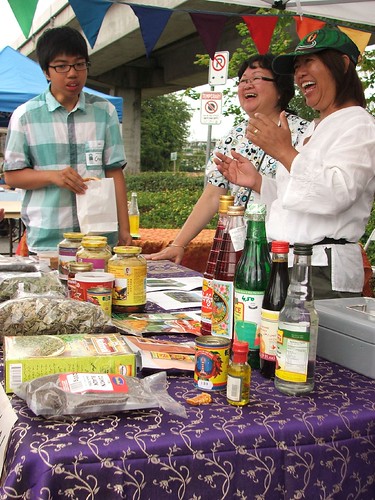
Volunteers at the International Spice Market
CNH volunteers Crecien, Evelyn, and Tammy chat about recipes at the International Spice Market stall.

Scott and Rob providing free bike tune-ups
The evolution of transportation: free bicycle repairs under the Skytrain tracks on the site of the old Interurban line.

Nigerian ugwu leaves alongside dried tamarind leaves and tom yum paste
Spices from around the world, generously contributed by local merchants: Joyce-Way Market, Hafiz Halal Meat Shop, and African General Market.

sampling deep-fried Chinese donuts from the Golden Fortune stall
Sampling deep fried Chinese-style donuts from the Golden Fortune hand-pulled noodle stall.

Collingwood Multicultural Summer Market: Vanness Avenue

Tuesday, July 21, 2009

TOURS with Spring Gillard, author of Diary of a Compost Hotline Operator

Exploring the Food System on the West Side: Summer Tour Series

Westside Waste Tour
Wednesday, July 29th 6:30pm to 8:30 pm
In 2007, about 3.6 millon tonnes of solid waste was generated in Metro Vancouver. Current initiatives like recycling, backyard composting, municipal leaf and yard waste composting are diverting over 50% of those materials. Metro Van has adopted the Zero Waste Challenge and hopes to get to 70% diversion. So how are we doing waste-wise on the west side? Come poke around in back alleys, garbage cans and compost bins with us. We’ll look at how grocery stores and restaurants are managing their waste. Are any of them composting? If not, what are the barriers? We’ll see a unique mid-scale composting system designed a local co-op housing development. We’ll check out some backyard bins too; 46% of Vancouverites are already composting in their backyards – many of those west siders! Learn about food recovery programs and innovative initiatives designed to waste not. Find out what you can do in your own backyard to reduce edible and inedible food waste.

The Gauntlet: A Look at the Emergency Food System
Wednesday, August 26th 6:30pm to 8:30pm
As we walk in our west side neighbourhoods, many of us run the daily gauntlet of outstretched hands, from the homeless to the NGO’s. We look at the emergency food system and the charity model and ponder: to give or not to give? Talk to service providers and learn about food programs on the west side that cater to vulnerable populations, as well as other initiatives that help increase access to fresh fruits and vegetables for all.

Food system tours $35 each. Register at info@gardenheart.com.

Presented by Garden Heart Productions (compostdiary.com)
and the Westside Food Security Collaborative (kitshouse.org/ link on community)

Sustainability Tours

Simon Fraser University (SFU) Applications Course – Oct 1-3.
Registration for full certificate program closes JULY 17

I co-teach this course which is part of the new certificate in sustainable community development jointly offered by SFU’s City Program and the Centre for Sustainable Community Development. It’s basically a three day tour. Here are a few highlights from last year. Vista D’Oro Farms, a beautiful diverse farm. After a discussion of food security and the agricultural land reserve, we sipped wine and shopped for artisinal preserves at their farmgate shop. Still Creek, one of Vancouver’s only remaining urban streams. Vancouver Film Studios and Canadian Tire have contributed to daylighting and restoring sections of the buried stream as part of their development agreements with the City. We also got a tour of the Film Studios and heard about their zero waste strategy. Regrettably for some, we did not see any stars. We went to the landfill and talked garbage. And we did a walking tour of Hastings and Pender and learned why one street had plenty and the other was a food desert. Find out more (including last year’s itinerary) at:

Gaining Ground Conference Tours: OCT 19-23
Register now for the tours in October at the Gaining Ground Conference. The theme this year is Resilient Cities: Urban Strategies for Transition Times. I will be leading four, resiliently themed tours along with the help of other experts. Visit a farm, stroll our green streets, walk through the infamous downtown eastside and the soon to be famous 2010 Olympic site.

With any tour registration, receive a one-time $50 coupon that can be applied to subsequent Simon Fraser University (SFU) City Program 2-day courses, in either the Sustainable Community Development program or the Urban Design Program. http://www.gaininggroundsummit.com/vancouver2009/vancouver2009_theme.htm


About Spring Gillard
After abandoning a successful advertising career, Spring Gillard worked at City Farmer, an urban agriculture group for 14 years. Her book Diary of a Compost Hotline Operator, Edible Essays on City Farming (New Society, 2003) recounts her adventures there. The book won a Garden Globe award of achievement from the Garden Writers of America. She has been published in numerous local and international media including Audubon, Organic Gardening, the Vancouver Sun and the Globe and Mail. She is currently finishing up a second book, this one on the politics of food.

Spring has spoken at events across North America including the Seattle, San Francisco and Vancouver Garden Shows and was keynote speaker at the American Community Gardening Conference in Toronto. She has given talks, developed and delivered courses, workshops and tours for numerous organizations and academic institutions including Simon Fraser University (SFU) and the University of British Columbia (UBC).

She has been interviewed on BBC radio, had a regular radio segment on CBC’s North by Northwest, was a popular and repeat guest on CBC Almanac, Sounds Like Canada and The Vicki Gabereau TV Show.

Spring sat on the Vancouver Food Policy Council for two and a half years and now volunteers with the Westside Food Security Collaborative. She is an associate at SFU’s Centre for Sustainable Community Development and co-teaches the Applications Course for a new certificate program in sustainable community development jointly offered with City Program.

Through her communications company, Garden Heart Productions, Spring plans special events, organizes green tours and helps promote a variety of groups working on sustainability and food security issues. compostdiary.com

Spring Gillard
Garden Heart Productions
Ph 604.714.1394/Fx 604.714.1396
www.compostdiary.com

Sunday, July 19, 2009

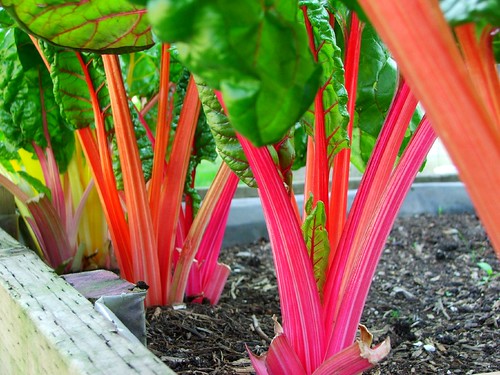
rainbow chard
[Rainbow chard at the Collingwood Community Gardens]


Mid-summer bounty.

This agricultural season got off to a bit of a rocky start, considering the extended cold temperatures and long stretches without regular rainfall. With the care of local gardeners, the Rooftop Garden and the Collingwood Community Gardens are taking off in a big way.


Here, a community gardener is growing yellow zucchini--bursting with fresh summer flavour! Zucchini typically grows on long wandering vines. This is a hybrid variety which grows in compact bush form. It's an excellent choice for small spaces and container gardening.

For information on growing zucchini and other summer squashes, or to find the right variety for your space, check out the West Coast Seeds website or the Seed and Plant Sanctuary.

early french fingerling potatoes

silvia

Community Gardener Silvia digs for French fingerling potatoes on the Rooftop Garden. Silvia offers this advice for would-be potato growers:

Potatoes sometimes grow just beneath the soil surface and may be exposed to sunlight. This can give the potatoes a "sunburn"--discolouration and a change in texture. To avoid this, mound additional dirt up around the base of the stalk as the potatoes are growing.

potato fruit.

Potatoes, tomatoes, and eggplant are closely related. We eat the roots of potatoes and the fruits of tomatoes, so this relationship is hard to imagine. Last week during Rooftop Garden Drop In (Tuesdays 1-3pm), Shannon and Sandra came upon the interesting garden find pictured above.

They're the fruits of the potato plant! They look a lot like unripe cherry tomatoes but they are quite toxic and can't be eaten. If you're growing potatoes in your garden and there are children around, they are a great teaching tool...but certainly not great for snacking.

Big thanks to Rooftop Garden Team Member Sandra for doing this research!

yoko

Here is Yoko on the Rooftop Garden with some freshly harvested garlic. Yoko was artistic director of last summer's incredible Rooftop Garden Tile Mosaic Project. She continues to visit the garden and help out when she can.


Garlic, like other bulb plants (tulips and daffodils) is best planted in the fall. It takes 9 months to grow to maturity.

Last November, we planted cloves of garlic left over from a Chinese-themed community kitchen. It was snowy and cold that day, and some folks were worried--but look how lovely the garlic grew out.

Rooftop Garden Team Member Jason was the first to make use of the new garlic crop. He and a group of students from Vancouver Technical Secondary (Van Tech) used the garlic to make pizza sauce during a community history workshop. They report the garlic to be sweeter, stickier, and more aromatic than the kind you find at the grocery store.


Here I am with freshly harvested garlic. In the background, you can see a bit of the Tile Mosaic project, some thriving basil plants, more garlic, and a dwarf sunflower getting ready to bloom. The basil was delivered by Yoko and planted by Scott. The sunflower was planted by Mayan farmer Maximo during a Families Branching Out planting workshop.

Friday, July 17, 2009

Community Kitchen Leader Position

The Trout Lake Cedar Cottage Food Security Network is looking for a Community Kitchen Leader who is an enthusiastic advocate for peer-to-peer learning and cross cultural collaboration. The CK Leader will have their Level 1 Food Safe Certificate, have completed their Vancouver Fresh Choice Kitchen's "Community Kitchen Leadership" training and will be interested in working with a diverse group representing a wide range of economic situations, ethnic backgrounds, abilities and cooking experiences.

This volunteer position requires about 12 hours per month of time. The CK will occur twice a month on Wednesdays (or perhaps Thursdays) from 6:00pm-8:30pm, starting in September 2009 and running until the end of March 2010.

Fresh Choice Kitchens is generously helping the Network to fill this role. For details see the volunteer posting here.

Tuesday, July 14, 2009

Blooming Biennials

Last week’s Garden club workshop on seed saving was successful. Last Thursday, a half dozen of us convened in the rooftop garden after dinner, to discuss seed saving while enjoying the early evening sunshine. After a 20 minute discussion on plant genetics, heirloom seeds, and differences between industrial and organic agricultural practices, we got down to business in the garden.

In the rooftop garden here at the Food Security Institute, we have several common food plants that have gone to seed. Right now our carrot plants are in full bloom, with flowers that size of softballs blooming from the ends of four foot long green stalks. Most of us had never seen a carrot that had gone to seed before. Why? Carrots (and cabbage, beets, turnips, celery, leeks, and parsnips, to name a few) are biennial plants. This means they only produce seeds in their second season of growth.

The carrots in our rooftop garden were planted last year, left in the garden over the winter, and then flowered in their second year. In most areas of North America, winters are too cold to leave biennials in the ground, as the cold temperatures will kill the plants. Gardeners in places like Manitoba have to dig up their biennials, store them in sand or dirt in a root cellar al winter long, and re-plant them in the spring if they wish to save their biennial seeds. Fortunately for us on the BC coast, we usually can skip these steps. I think that perhaps this particular crop of carrots might be especially cold-resistant, after having survived our last winter! I am looking forward to saving seeds from these carrot plants, and testing that theory next year.

We also examined some lettuce, spinach, radishes and collard greens that had gone to seed. After the garden tour, we sat down with some of last year’s dried collards, cabbage and mustard plants to practice removing the seeds from the dried seed pods. We spent the remainder of the workshop chatting and removing seeds. After the workshop, everyone got to take home some seeds to plant in their own gardens. A fun and educational evenings was had by all. The next Renfrew Collingwood Garden Club meeting will be on Thursday, August 13th, at 7:00 pm. Please come join us. Beginners, experts and everyone in between are all welcome.

-Posted by Shannon

Wednesday, July 8, 2009

blue-podded peas, OP heirloom variety (c.1500, Holland...at least we call it Holland today).  happy faces by January Wolodarsky.
Dutch pea strain Blue Capujiner, also known as Blauwschokkers. Seed grown and saved at the RCFSI Rooftop Garden. Happy faces etched by January Wolodarsky, Director of Community Development.


The importance of seed-saving.

This month's Renfrew Collingwood Garden Club topic is seed-saving skills. Shannon Rees, our RCFSI Practicum Student and former UBC Farm volunteer, will be leading a workshop on the process and importance of seed-saving.

Ever since humans began growing food, we have been passing on seed-saving skills from generation to generation. Long before there were seed catalogs, garden centres, or hardware store, families saved seeds from favourite edible plants to pass on to friends or family members.

These days, many home gardeners choose to purchase seeds each year rather than save seeds at the end of each growing season. Since there are many convenient options for finding seeds, seed-saving skills are disappearing--but saving your own seed eliminates the cost of buying seeds each year. It also allows you to save seeds from plants that do particularly well in your specific yard's soil, or in the light conditions on your balcony. Careful seed selection can save you money, reduce gardening disappointments, and lead to more bountiful harvests down the road.


Heirloom varieties.

The unusual blue-podded pea pictured above is one example of an heirloom vegetable variety. It is a Dutch variety that was developed in the 1500s, and it produces lots and lots of peas and big delicious pea leaves.

There is a lot of discussion on how to define "Heirloom Variety"--some say the strain must be at least 100 years old, others say 50 years is old enough. The important difference between heirloom varieties and an increasing number of fruits and vegetables at the grocery store is that certain kinds of plants have been genetically modified. This means scientists have made changes to the genetic makeup of plant seeds to produce desired qualities--large fruits, bright colours, disease resistance.

In the old days, people would carefully select and save seeds over many years to produce desired qualities, which is why we have heirloom varieties. The difference between the old heirloom varieties and the new genetically modified versions is that the genetically-modified (GMO) versions are copyrighted.

Some plants are genetically modified so that they will not produce fruit at all if the seeds are planted, or they will produce infertile seeds. Saving seeds from some of these GMO foods is technically a crime, which can be very confusing since they are not labeled as genetically modified.

Today, the increasing number of GMO plants threatens the independence of farmers around the world. Would you like to learn how and why?

For a discussion on these important topics, and for hands-on demonstrations on seed-saving and storage, please come down to the Garden Club on Thursday July 9! We look forward to seeing you.


The Renfrew Collingwood Garden Club meets on the second Thursday of the month to share, socialize, and celebrate topics in urban growing. Staff Lounge, 7-8:45pm.

Saturday, July 4, 2009

by the pound

The world in a box.

Collingwood Neighbourhood House, The Renfrew Collingwood Food Security Institute, and the City of Vancouver are pleased to present the Vanness Avenue Multicultural Summer Market. Located once block west of Joyce-Collingwood Skytrain Station, this small open-air market will take place:

July 26
August 2
August 9
August 16
August 23

10am-2pm

This intimate open-air market will feature multi-ethnic local farmers whose produce reflects Vancouver's cultural diversity. The market will also showcase local performers, artisans, and a bicycle tune-up station.

We are proud to collaborate with several local businesses to present an International Spice Market. This stall will feature rare and hard-to-find specialty items such as: Tunisian harissa, quince syrup, rose water, lephet (Burmese tea), dried banana heart, methi (fenugreek leaves), and za'atar. We will also feature an assortment of spice mixes from North Africa, the Indian Subcontinent, and South and Central America.

The Spice Market is a simple way for local businesses to promote their businesses while contributing to community. Many neighbourhood shops are small family operations with limited staff and/or financial resources.

All proceeds from the Spice Market will support Renfrew Collingwood Food Security Institute initiatives. These include a Breakfast and Shower program for homeless, cooking classes for low-income pregnant women, and food skills workshops for new immigrants.

"It's mostly me and my husband here [in the shop], and we don't have too much time," explains the proprietress of Hafiz Halal Meats (4940 Joyce St.), "but I'd love to help the homeless. We are happy to help."

The Spice Market will take place alongside the Recipe Trading Post, where visitors can find recipes for rare and unusual spices, trade family recipes, and trade used recipe books.

We look forward to seeing you there!

Thursday, July 2, 2009

Join Us! Summer Happenings at the Food Security Institute

My name is Shannon, and I’m the 2009 summer practicum student at the Renfrew Collingwood Food Security Institute. I am thrilled to be part of the exciting happenings at the Food Security Institute, as food security and sustainability have been passions of mine for many years.

I will be working with Stephanie Lim, the Food Security Coordinator, on several interesting projects. We invite you to get involved with the Institute by attending an event or a workshop, volunteering, or in any other way you would like. If you would like to share your thoughts about food security in our community, you have questions, or you have an idea for an event or project, please do contact me at rcfsiintern@cnh.bc.ca


Food and Culture Stories from Seniors and Community Cookbook Project

Collingwood Neighbourhood House will be publishing a cookbook later this year, composed of recipes from our community kitchen, family recipes donated by community members, and recipes from the trading post at our upcoming summer markets.

We would also like to include in the cookbook food-related stories from seniors in the Collingwood community. Stories could be on a wide variety of topics. For example, how is the food system different now compared to when the senior was young? What kinds of foods are eaten in their culture for different holidays? Did the senior grow up on a farm? Do they garden? Maybe they worked in a restaurant?

If you know a Collingwood senior who would like to share their food-related stories, opinions, thoughts or anecdotes in our cookbook, please contact me at rcfsiintern@cnh.bc.ca I will be conducting interviews with seniors throughout the summer, at a time and location convenient for them (seniors do not need to submit a written story). If a senior would like to be interviewed in a language other than English, I can bring a translator. If a senior would prefer to submit a written story, that is great too!


Rooftop Garden

Thanks to the dedicated efforts of the Rooftop Garden Leadership Team, the rooftop garden at Collingwood Neighbourhood House is currently in full bloom, with a variety of vegetables, fruits, herbs, edible flowers, and medicinal and ceremonial plants. Food grown in the rooftop garden is used in various meal programs at CNH, which serve seniors, families with young children, youth, and homeless people in the Renfrew Collingwood community.

Every week throughout the summer, we will be having a drop-in gardening party on Tuesday from 1 to 3 pm. Please feel free to come out and join us on the rooftop garden. Everyone is welcome, and no gardening experience is necessary. This is a great chance to learn how to garden, meet your neighbours, enjoy the sunshine, and help to grow food to share with your community. If you would like to volunteer in the garden at other times, or you have any questions, please contact me at rcfsiintern@cnh.bc.ca


Collingwood Multicultural Summer Markets

For five consecutive Sundays (July 26th to August 23rd), CNH will be hosting a multicultural farmers’ market on Vanness Avenue, adjacent to Joyce Skytrain Station. The market will feature fruits and vegetables from local farmers and gardeners, with an emphasis on foods from diverse cultures and cuisines. There will also be a spice vendors’ market, local artisans and performers, and a recipe trading post. At the recipe trading post, community members can swap recipes with their neighbours, and perhaps learn to prepare some new types of foods. We are seeking volunteers for all areas of the market, including the recipe trading post. Volunteering at the market is a great way to meet people, try new cuisines, and support your community. To volunteer, please contact me at rcfsiintern@cnh.bc.ca


Blackberry Festival

The annual Blackberry Festival will be on Saturday, August 29th. This festival celebrates the tastiness of the Himalayan Blackberry, while also raising awareness about the environmental effects of this invasive species. Events leading up to the festival include a berry picking day in the Renfrew Ravine, and a blackberry jam making workshop. The festival will feature blackberry jam, juice and baked treats, and music, crafts, games, and information. If you would like to volunteer for the Blackberry Festival, or would like to participate in berry picking or jam making, please contact me at rcfsiintern@cnh.bc.ca